muchymozzarella:

Please reblog this even if you don’t care

They’re trying to erase the existence of the rape victims of Japanese soldiers in World War II because they think the reminder of their crimes might make Japan a little bit cross

Duterte, the absolute coward, is more worried about women criticizing him than actually honoring the women this country needs to remember

Please don’t let these women be silenced.

I stand in solidarity with the Filipinas who suffered as our grandmothers did. You are our grandmothers, too.

Isn’t Forrest Whittaker… old? Wasn’t Saw a teenager in TCW? I’m only just now realizing that Saw should look more like late thirties instead of early fifties. Unless I’m bad at math or there’s an explanation

themandalorianwolf:

Good point, but yeah, pretty sure they aged Saw up like hell.

TCW takes place 22-19 BBY, so if Saw was a teenager during TCW he’d have been born something like 40-36 BBY. Rogue One takes place 0 BBY, so yeah, Saw would have been in early middle age at best, while Forrest was 55 at the time RO came out–and like op said, looked even older as Saw. I mean maybe it was to make him a plausible father figure to Jyn, but I didn’t see Mads get aged up so he could be Jyn’s dad.

teenvogue:

This Documentary Shows How the U.S. Government Took Indigenous Children From Their Homes

Dawn Adams was only a child when her mother’s parental rights were terminated by the United States government; two years later, her adoption process began. Then, at age 15, Adams, a child of the Wabanaki community in Maine, was taken from her home and placed in foster care. Like other Indigenous children throughout the U.S., Adams, who was named Neptune prior to her adoption, was led to believe that her people didn’t want her, and was placed with a white family to live out the remainder of her childhood.

The Maine resident is just one of the many Indigenous people profiled in the new documentary film Dawnland, which puts a spotlight on the United States government’s history of systematically taking Native American children from their homes and placing them with white families. The film, directed by Adam Mazo and Ben Pender-Cudlip, was produced by the Upstander Project, a Boston-based educational collaborative founded in 2009 that aims to raise awareness about social injustice, turning “bystanders” into “upstanders.” Dawnland, which airs on PBS at 10 P.M. EST on November 5, centers around the United States’ first government-sanctioned Truth and Reconciliation Commission (TRC) in Maine, which gathered testimony from Wabanaki families who were affected by this practice.

Mazo was initially drawn to the film’s topic when he first learned of the TRC from a 2013 NPR broadcast. At the time, his team was promoting their documentary film Coexist, about the 1994 genocide in Rwanda. “We would often say at workshops, ‘We’re teaching about genocide in a far away place, but we also want to acknowledge genocide in this country’s history,’” Mazo told Teen Vogue. “We were actively wondering how we could teach more about genocide in this country’s history when we heard about the commission.”

The specific instances of devastation and loss highlighted in Dawnland are reflective of the way the U.S. government has historically treated Indigenous families. According to the National Indian Child Welfare Association (NICWA), by the 1970s, approximately 25-35% of all Native children in the U.S. were being removed from their homes, and 85% of those children were placed with families outside of their community. In 1978, the U.S. government passed the Indian Child Welfare Act (ICWA), which established standards for the placement of Indigenous children in foster homes, and required courts to involve the child’s tribe and community in all decision-making. However, these issues are not a thing of the past; the NICWA notes that even today, Native families are four times more likely to have their children removed from their home than white families. Additionally, Native children are overrepresented in the U.S. foster care system, which, according to the NICWA, “has increased trauma” to Indigenous families.

Continue reading

📸: Ben Pender-Cudlip, Upstander Project

tariqah:

zanabism:

oakttree:

xmagnet-o:

zanabism:

if you’re not committed to antiracism, you’re not a good doctor. 

I remember when I had pneumonia I was so sick and exhausted and in pain that I couldn’t get out of bed for *days* — I eventually pushed myself to walk across campus to the doctor’s office (it took me literally 45 minutes to walk there bc I had to walk so slow) and when I got there…the doctor made it seem I was only trying to get out of writing an exam lol. I was too embarrassed to tell her that I was going to be withdrawing from the class anyway bc I hadn’t had the energy to get to lectures at all that semester. She lectured me about how she sees students do this all the time and she can’t take a risk in trusting me when the only thing that was wrong with me was exhaustion. “We all have off days” is what she said lolol. 

I was so humiliated at her insinuation that I eventually just nodded when she said it “didn’t seem like I had any issues” and went back home. It wasn’t until I fainted walking down the hallway like 4 feet outside my apartment that I started panicking and called someone to take me to the hospital. When I got there even the receptionists looked genuinely pale to see how hard it was for me to walk and how much it hurt to breathe or talk.

It would take *6* different antibiotics for the really advanced pneumonia to finally die out, the last of which was delivered intravenously in my arm for 10 continuous days — I still have the scar where the initial IV was and I have another mark on my wrist. I *literally* couldn’t walk or lay on my back for 8-9 weeks. I would sleep sitting up with pillows on a chair and when my breath would involuntarily deepen as I started to fall asleep I would jerk awake bc of the sharp pain my lung where the pneumonia was.

That same doctor who thought I was lying about being sick would then call me like 34 times in a row when my blood test results came to her office and the hospital sent her my chest x rays lolol, obviously worried about looking bad and having called me a liar and sending me home when I had such a serious bout of pneumonia.

In the 3rd year of my premed degree I would learn that doctors in North America — and specifically white women in nursing lol — often see south Asian women as malingerers who exaggerate their pain. In a UK study there were neonatal nurses who went so far as to say that south Asian women also lack maternal instincts, care more about their pain meds than their child and “can’t handle” child birth.

Yosif al Hasnawi — an Iraqi Canadian teen — died at the hands of two paramedics who did not believe he had been shot and claimed he was “acting” when he was actually internally bleeding. They made him walk to the ambulance with a bullet in his stomach, from which he would later die after not being transported to the hospital for 38 minutes.

Just yesterday My cousin, totally healthy, just died of a brain hemorrhage and often complained about ongoing migraines that could’ve been telltale signs of hypertension that were totally ignored by her doctor for years.

and just a day before that Kim porter who was otherwise healthy just died of pneumonia while having expressed her symptoms and pain to doctors for days — I would say that I’m shocked by this but the implications faced by brown people and racism in the healthcare system is 10x worse for black women who are often seen as liars and in it for the meds as a result of historical anti blackness and systemic rejection of black patients’ pain.

doctors are literally trained to perceive racialized people as malingerers who are trying to scam for meds or medical attention instead of people in pain. It’s 100% systemic and actually integrated into medical education.

Yeah exactly this

Medicine is no less likely than any other field to have problems with racism. But when it’s someone’s life at stake (or at minimum someone’s comfort), it is really critical that this kind of prejudice is rooted out.

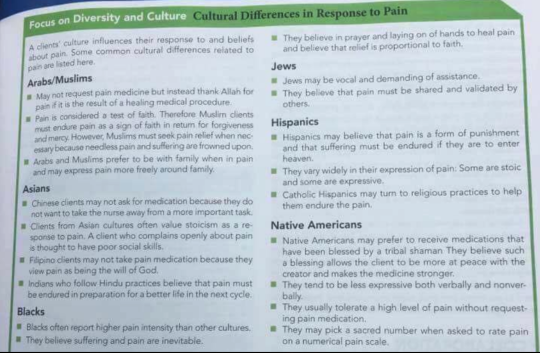
Most likely everyone’s seen this notorious page from a nursing textbook, but in case you haven’t, enjoy some piping hot medical racism:

…this is ….published in 2014….i don’t know what to say

All of them are talking about how we pray the pain away or overreact to the pain… amazing

jewishcomeradebot:

Just had something that might be a completely wild thought, but what if the mysterious “Caro” who’s played by Naomi Ackie

is really Tam Ryvora from Resistance?

I mean, Caro is definitely a cover name anyway, I’ve just been using it because we don’t know the part’s real name.

Idk, it just kinda hit me and I thought I’d share the thought.