Um? This is the woman who was confirmed, over and over again, to have put her ambitions ahead of the good of others, of Bajor, or indeed the universe. She also ummm tried to assassinate her opponent (Bareil)? Which would make anyone a villain? But that’s not close to all of it, you even brought up the pah wraiths yourself–i.e. her last arc in the show, where she was going to burn Bajor down and kill the Prophets because they liked Sisko better than her. I’m not sure what Berman meant by violation, certainly Dukat raped her by deception and no one deserves that. Here’s some news, though: suffering a wrong does not in itself make you a good person.
Star Trek: Deep Space Nine was not a perfect show but its treatment of imperialism, war crimes, and genocide was light-years ahead of some of the stuff coming out today (looking at you, Star Wars).
In DS9:
Bajor, a world struggling to recover from decades of genocidal colonial policies, is front and center
Bajoran characters, most prominently Kira, are allowed to grapple with their own trauma and their stories don’t revolve around making their oppressors, the Cardassians, feel better
Kira’s history of violent resistance against the occupation is not sugarcoated, nor does the show shy away from the fact that she hurt innocent people in the process. But neither does the story condemn her for using violence to resist genocide
Not only was Kira a terrorist, but a religiously driven one as well. Belief in the Prophets held Bajor together during the occupation, and is a major subject of exploration in the show
Despite all that Bajor suffered, Bajorans are not relics of the past or a destroyed, defeated people–their culture is vital and alive, they are rebuilding against incredible odds, and are working toward Federation membership
Bajorans themselves are not some misty spiritual cardboard cutouts, either. They are complex, they lash out, they are spiritual, they are lovers, killers, reactionaries, weirdos, mystics, the full range of experiences and personalities
And then there’s Kai Wynn, who is an entire book in herself. She is such a well-drawn female villain, a complicated portrayal of self-serving ambition, self-deception, and self-entitlement
Because Bajorans are given their own stories, it actually works when some Cardassians–generally minor and one-off characters–are shown to be dissenters, or themselves traumatized from the occupation
We actually see Dukat, the leader of the occupation, trying to play the misunderstood hero/redemption card only to get slapped down by the narrative time and again
Dukat isn’t a one-note villain either; he is often charming and sometimes inspiring, as when he has a stint as a resistance fighter himself against the Klingons occupying Cardassian territory
Ultimately, though, the story reveals Dukat to be a liar, a virulent racist, an abuser, and at heart an imperialist megalomaniac who almost destroyed the Alpha Quadrant with his lust for power
David Brin was right and Star Trek is better
Can we also mention the fact that (spoilers) Bajor never joins the Federation? Which isn’t to say the Federation were secretly evil (although, at various points during the 7 seasons, they totally were), but rather that the Bajorans had a right to self-determination, and that while they’d been broken by the Cardassians, they didn’t need to join the Federation to become whole again. It was a rare story beat, as usually cultures either join the Federation and presumably live happily ever after, or refuse to join the Federation in order to retain some (almost always) regressive, oppressive, or barbaric aspect of their culture.
The fact that the Bajorans were not only a highly spiritual culture (something extremely rare in what we see of the Star Trek universe), but were also never criticized or demeaned or looked down on for their choices was kind of awesome. I am an atheist through and through who loves the secular vision of humanity that Star Trek represents, but it’s also deeply satisfying when the Federation lives up to its actual mission statement of helping other cultures without assimilating them, or othering them from their own traditions.
I was a little bummed when I saw that one of the novels had written that Bajor eventually joined the Federation, because it felt so anticlimactic to everything that had happened in DS9. Bajor was its own thing–they were flying in space when our captains were still dying on transatlantic sea trips. We were just there to help them out after a horrible tragedy, not use that as an excuse to add them to our ever-expanding network of planetary satellite states. Sisko understood that, in the end.
I thought Bajor was determined to join the Federation and it was only Sisko’s vision that caused it to delay at literally the last minute? The Prophets commanded the delay for Bajor’s self-preservation and not for deeper philosophical and religious reasons, as I recall, because by not being a member of the Federation Bajor could maintain neutrality when Starfleet was forced to vacate DS9 and the Dominion/Cardassia took over. That episode was a gripping take on the conflict between rationality and spirituality, something I agree with you is a rare and refreshing take for Star Trek. Sisko’s whole arc was great for that reason, really.
I agree Bajor doesn’t need the Federation to be whole but there were benefits to joining that it decided it wanted, like the military aid and those sweet sweet trade deals. The only other time Bajor’s future with the Federation was in doubt, and which would have been in the direction of “refus[ing] to join the Federation in order to retain some (almost always)
regressive, oppressive, or barbaric aspect of their culture,” was when the planet toyed with the idea of returning to a caste system which indeed would have axed any possibility of Federation membership. I think we can all agree that Kira not making any more sculptures was a mercy, though. Also this is totally shallow, but my God she looked good in a Starfleet uniform.
I think one of the major questions that DS9 explored was whether the Federation is a colonializing or assimilating force. At least in theory it fully respects all its member worlds’ beliefs that are not oppressive (see caste system, above), but another thing I loved about the show was its sharp critiques of the Federation from all directions, from disillusioned former Starfleet officers to characters like Quark from non-Federation worlds. You can also see how overbearing the Federation’s worldview is when Sisko, effectively a convert to the Prophet faith, constantly has to choose between being a Federation officer and being the Emissary. As another atheist who really likes the secularism of the ST world, I also loved this critique of the Federation’s secularism and its narrowness.
I tried to read the novels but found the first book too boring, so nothing that happened in them is canon as far as I’m concerned. I liked A Stitch in Time but that’s about it. I don’t think there’s anything wrong with Bajor joining the Federation, but it would be even more interesting if they decided it wasn’t who they were. It would be a breath of fresh air, I agree, if a democratic world that isn’t “evil” in some way decided the Federation wasn’t for them.
Star Trek: Deep Space Nine was not a perfect show but its treatment of imperialism, war crimes, and genocide was light-years ahead of some of the stuff coming out today (looking at you, Star Wars).
In DS9:
Bajor, a world struggling to recover from decades of genocidal colonial policies, is front and center
Bajoran characters, most prominently Kira, are allowed to grapple with their own trauma and their stories don’t revolve around making their oppressors, the Cardassians, feel better
Kira’s history of violent resistance against the occupation is not sugarcoated, nor does the show shy away from the fact that she hurt innocent people in the process. But neither does the story condemn her for using violence to resist genocide
Not only was Kira a terrorist, but a religiously driven one as well. Belief in the Prophets held Bajor together during the occupation, and is a major subject of exploration in the show
Despite all that Bajor suffered, Bajorans are not relics of the past or a destroyed, defeated people–their culture is vital and alive, they are rebuilding against incredible odds, and are working toward Federation membership
Bajorans themselves are not some misty spiritual cardboard cutouts, either. They are complex, they lash out, they are spiritual, they are lovers, killers, reactionaries, weirdos, mystics, the full range of experiences and personalities
And then there’s Kai Winn, who is an entire book in herself. She is such a well-drawn female villain, a complicated portrayal of self-serving ambition, self-deception, and self-entitlement
Because Bajorans are given their own stories, it actually works when some Cardassians–generally minor and one-off characters–are shown to be dissenters, or themselves traumatized from the occupation
We actually see Dukat, the leader of the occupation, trying to play the misunderstood hero/redemption card only to get slapped down by the narrative time and again
Dukat isn’t a one-note villain either; he is often charming and sometimes inspiring, as when he has a stint as a resistance fighter himself against the Klingons occupying Cardassian territory
Ultimately, though, the story reveals Dukat to be a liar, a virulent racist, an abuser, and at heart an imperialist megalomaniac who almost destroyed the Alpha Quadrant with his lust for power
David Brin was right and Star Trek is better
The origin of this episode is to be found in Ira Steven Behr’s love for the 1949 Samuel Beckett play Waiting for Godot; Behr had always wanted to do an episode with Odo in the role of Vladimir and Quark in the role of Estragon. The problem Behr had was with the story. The play has no discernible plot at all; it is simply about two characters sitting around waiting for something undefined and something which never arrives, and they spend most of the play insulting one another. According to Behr, the only plot he could come up with for a Deep Space Nine episode was having Odo and Quark waiting somewhere for Sisko to bring them a runabout, but they’ve no idea why or how long they’ve been there.
I don’t think about crossovers as much as I used to, but if cassian “I’ve been in this fight since I was six years old” andor could meet up with kira “I am just a bajoran who has been fighting a hopeless fight against the cardassians all her life” nerys for a joint resistance story, that would be pretty fucking awesome
A disruption in the space time continuum takes Kira’s team to an uncharted planet where they meet up with a ragtag group who call themselves “Rebels.” She agrees to help the group, led by Cassian Andor whom she finds she has much in common with, clear Imperial forces from an observatory that may hold the key to her team’s return. But when the local Imperial commander offers to cut a deal where the Imperials will return her to the Alpha Quadrant in exchange for withdrawing from the fight, what will she do?
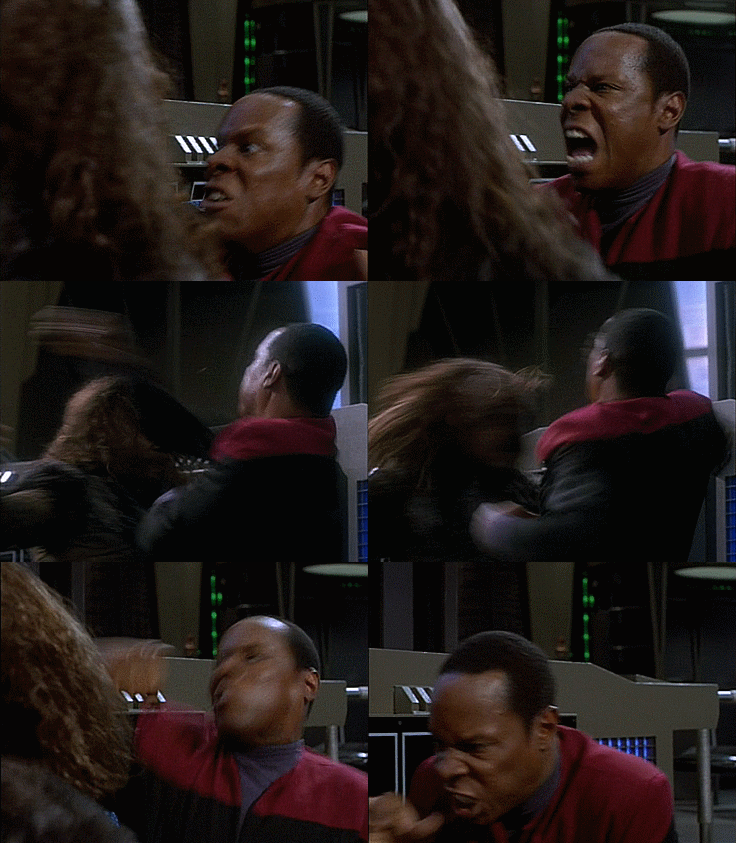
I am waiting for the day someone asks me “hahahah Kirk or Picard?”
Because
It’s
Mother
Fucking
Sisko
The one crisis that genuinely threatened my marriage early on was when I started marathoning Star Trek: Deep Space Nine and could not… fucking… stop. My poor husband would come home to me watching episodes late into the night and the wee hours of the morning, and we had to sit down to have a serious talk about how I was all but ignoring him for the show.
A few years later when we found out a mutual friend was a big DS9 fan who had watched the show three times, we told him laughingly about this incident. The friend told my husband he was in the wrong. “You should have been watching with her.”
We are now halfway into Season 7 on my second rewatch and my husband’s first. We recently celebrated our fifth anniversary, we have a toddler together, and we couldn’t be happier. The moral of this story is that the key to marital harmony is watching DS9 together.
(Before anyone jumps down my throat, the part about my husband being in the wrong is A JOKE. Of course I shouldn’t have been watching the show so excessively, and I made adjustments after our talk–mostly by finishing the show during the daytime, lol, but still. Anyone who comes onto this post whining about man-hating will be mercilessly mocked. And just in case anyone really is that dense, my husband and I did not actually have serious issues and DS9 will not in fact solve your marital problems on its own. It should, though, it’s such a damned good show.)




 L.J.'s Obsessions