shipping-isnt-morality:
Sincere questions for antis
If anyone feels like taking me up on it.
1. Where is the research on how media you consume can directly, negatively affect your values? Everything I’ve seen says that, on the whole, it makes you more empathetic and thoughtful, things which would be directly counter to the normalization of horrifying acts.
2. What is your basis for saying that what someone enjoys in fiction or fantasy is what they enjoy in real life, or would enjoy if they had a chance? You make fun of the argument “enjoying horror doesn’t make you a murderer”, but I’ve never seen a meaningful counter to that.
3. What is it about sex that makes something inherently bad? I’ve seen a lot of arguments along the lines of, “Portraying X is fine so long as it’s not sexual”, but isn’t being sexual a part of many people’s lives, good and bad? How are you coming to the conclusion that people universally endorse the reality of the ideas that they find sexually arousing?
4. Why do the needs of victims who are triggered by content overrule the needs of victim who find comfort in communities surrounding that content? Isn’t the solution to just keep the communities as separate as possible?
5. What is your goal? Do you really think removing all the content you find objectionable from a fandom is possible? Do you really want to leave a string of suicides in your wake of victims who blame their trauma on the fiction they chose to create and consume?
There questions are asked in good faith, and I’d love it if you answered in good faith. With reliable sources, if at all possible.
We have to talk. We have to. We have to come back to the middle, at least a little bit, or fandom and creative communities all over the internet are going to tear themselves apart. So: it’s possible that I’m wrong. I don’t think I am, but I try as hard and as often as possible to prove myself wrong, to combat confirmation bias. So: prove me wrong. How did you get to where you are, and what’s your evidence?
Fandom is a reflection of the real world, it isn’t what happens when “morally questionable” media is embraced.
When a movie or show has an inclusive cast of characters and fandom makes everything about white characters (and, for the record, this happens again and again across multiple fandoms, including Blade, Bright, and Orange is the New Black to name just a few), that says something about the real world. We know that something is harmful. The empathy gap – which can be summed up as feeling white pain but not Black pain – is real (https://www.ncbi.nlm.nih.gov/pmc/articles/PMC3108582/), and serious, and it’s on display every day in fandoms.
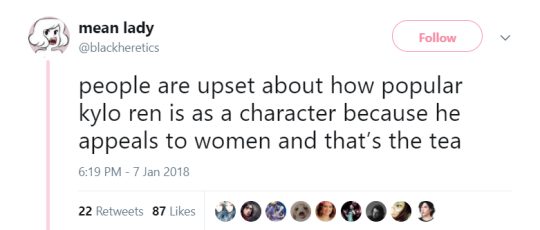
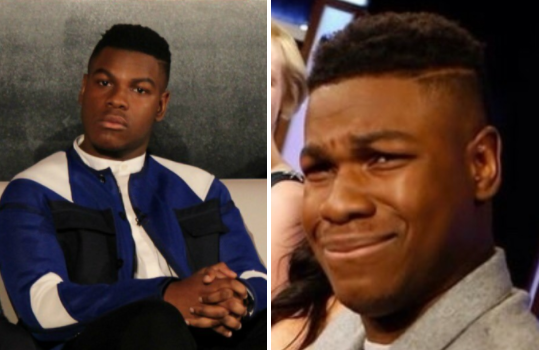
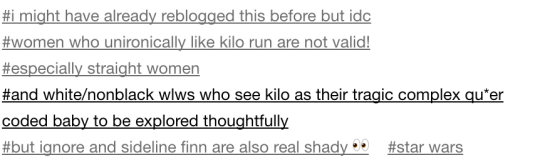
The Last Jedi didn’t make anyone more empathetic to Kylo than Finn. In fact, the narrative did not ask that of the audience at all.
Media does influence how we see the world, though. Decades of all white Westerns, for example, have acted as historical revisionism, causing people to believe that all real Old West “cowboys” were white. That is far from the truth (http://www.pkwy.k12.mo.us/west/teachers/boles/student_work/west_webfall08/DanB%20West/DanBDiversity.html).
And there have been studies showing that TV can, if fact, induce racism. (https://greatergood.berkeley.edu/article/research_digest/does_tv_make_us_racist). Findings of the Berkeley study include:
Researchers studied how viewers were affected by nonverbal behavior on 11 popular television shows, such as CSI: Miami. Characters on these shows displayed more negative nonverbal behavior toward African-American characters than toward white characters. Exposure to pro-white nonverbal behavior increased racial bias among viewers, as determined by a test that measures unconscious biases, even though viewers did not report noticing patterns of biased behavior on TV. This study suggests that subtle nonverbal behavior on TV can influence racial bias in the real world. —Kat Saxton
This is an interesting study, but the fact is, viewers will demonstrate bias against Black characters even without negative nonverbal behavior toward them. All they have to do is exist. (Citation: Many years of watching and participating in fandoms first hand.)
On Questions 4 and 5, my goal is not to remove shipping or shipping content, and I do not know any anti who thinks that’s a feasible goal. For the most part antis I know go to great lengths to avoid content we find objectionable, including filtering and blocking, and excluding some shippers from our own self-organized fandom activities like blog rings and Discord chats.
I think one main source of misunderstanding is that you as the op don’t see the difference between “This fandom trend is a reflection of real life biases and decreases the enjoyment of marginalized fans” and “This fandom trend must be forbidden altogether.” It is possible to criticize a thing without infringing on the right of others to enjoy it. Critique is not the same thing as prohibition, and the right to create and enjoy content doesn’t mean the right to be free of criticism.









 L.J.'s Obsessions