This whole idea that fans can’t handle change. Yeah ok. Before Disney got their hands on Star Wars, the EU was, for all its intents and purposes, the sequel trilogy for a lot of fans. It existed for over 20 years.
Let’s see:
A planet fell on Chewy and he died.
Han and Leia’s youngest son, Anakin Solo, died at 17. He was positioned as the “Luke” of the new generation and they killed him off in a heroic sacrifice.
Han and Leia became estranged.
Jacen Solo took up the mantle of Darth Caedus in his deluded mind to save the world from further war. He murdered his aunt, Mara Jade Skywalker.
He went after both his parents. Han gave up on Jacen.
Jaina Solo, his twin, had to fight and kill her brother to stop him. He doesn’t get “redeemed” but he does show concern for his daughter’s welfare and he still dies. At the end, Han and Leia live and raise Jacen’s daughter. Jaina is traumatized by what she had to do to her twin. Ben Skywalker, Luke’s son, is still alive. Luke is still alive.
As a EU fan, I bitched and complained about some of these plot points, mainly their execution, but I didn’t think it completely ruined character arcs! Did I like all their choices, no. But, even at the lowest point or even the least coherent point, I didn’t feel like the story had given up on these characters.
The Last Jedi made me feel dirty. It made me feel like I had naively fallen for a scam.
I am caught between being amused and wincing at the fact that Han and Leia can’t seem to stay together in any universe. And noooo Chewie…:( But yeah, even in the OT era, remember all the elaborate theories fans had about Vader between ANH and TESB? Fans love dramatic changes to the status quo and having their theories dashed. They just want it to be good.
There were even more change ups:
Han Solo for a short time was on the enemy side of another Civil War and his relationship with his family was strained.
Chewie died saving Anakin Solo, thus causing a rift between father and son that never really mended until it was too late and Anakin died.
Mara Jade was an assassin who was supposed to kill Luke Skywalker for the empire but she eventually fell in love with him.
Leia became a full fledged Jedi Knight, lightsaber and all.
Luke trained a new generation of Jedi and fought evil till the end, but Luke and his son were banned from helping the new Republic again.
The Empire returned under this blue fucker Admiral Thrawn and he was wrecking everybody.
Boba Fett escapes his own death, twice even, and returned to the planet Mandalore to unite the warrior culture and become one the EU’s most highly acclaimed characters.
The EU (Legends) vs Disney (Canon)
Even if you don’t know anything about the EU or think Disney had no reason to keep anything, everything Disney had they built it off of the EU.
Rey – She’s clearly based off of Ben Skywalker and Jaina Solo. Jaina Solo was a talented force user and pilot, as well as the one who had to kill her fallen brother to him. Ben Skywalker was pretty much the next hero of the franchise and trained under his father. That is why the Rey Solo/Skywalker theory exists.
Finn – He based of two characters as well. An imperial officer who would deflect from the Empire and become a Jedi. The second character is a Prince who is named Finn, which is why the royalty theory exists. His natural ability for battle also hints at a Mandalorion background since Mandalorions are warriors trained at birth because of their natural abilities.
Ben Solo/Kylo Ren – He is based off of Jacen Solo who adopted the name Darth Caedus when he fell to the Dark Side. Jacen was trained by Luke and became the biggest threat at one point before Jaina had to put him down.
That’s just the tip of the iceberg. Almost everything Star Wars is now was taken from the EU. There is a reason why fans of the old continuity take offense to this new Star Wars and the fans of it who don’t know anything about the EU.
Was it always perfect? No. There were many of times were things could of been done better or more satisfying, yet it still did amazing things.
It kept Star Wars alive and gave us stories people still love to this day. They also weren’t so damn annoying with their mystery and set the standard.
Luke Skywalker was very much like he was in the original trilogy, yet they explored and deconstruct it. Luke fell to the dark side, was almost murdered because he spared people, lost his wife and family members, students, and fought in battle after battle, only to keep getting hurt, yet he never gave up. Luke was the Superman of the EU. Not because he was godly powerful, yet because he refused to let evil win.
Han Solo made mistakes, became estranged from his wife and kids, even fighting on the wrong side of the war against the Republic. In the end though he always came back and did what was right. He stayed with Leia and never abandoned the fight.
Leia learned to become Jedi, helped run the republic, fought in wars, lost children, was almost killed so many times, yet through it all she remained strong and even at her lowest, refused to ever back down.
The EU created a new generation while continuing the stories of the old. They didn’t use the old characters to spring board the new characters.
The Skywalkers, Solos, and Organas had their children yet we had new original characters as well unrelated to them.
There is a reason we want Rey Skywalker/Solo – She is based of the children of Solo and Skywalker. She is almost an exact clone of Luke Skywalker and his story to the point of blatant plagiarism. And don’t even get me started about all hints that are dropped.
There is a reason why we want Mara Jade/Luke to have a wife and a kid (Rey). – Luke had a wife and child in the old canon and he still suffers, fight, but doesn’t give up. He fell in love, raised a child, trained the child and then to just take it all away and say we’re dumb for wanting Luke to have a shred of happiness is cruel and disrespectful to Luke.
The Reason we want Finn to be a Jedi or something meaningful – Finn’s entire background is based off of Imperial Officer turned Jedi, a Prince, and even shades of Mandalorions. The only argument as to why he shouldn’t be anything meaningful is because they want to keep pushing this nobody agenda.
Disney Star Wars is so focused on mysterious, bad subversion, and saying that even a nobody can do something heroic that their missing the biggest points.
Everyone is a Somebody
The whole point of Star Wars is that there are no nobodies. Everyone is a hero of their own story and special. They can become anything they wanted to be.
Boba Fett went from just a bounty hunter to the leader of an entire warrior culture. Luke is a farm boy turned Grand Jedi Master. There were no nobodies. Everyone mattered because Star Wars made them matter.
Subversion isn’t always the answer
The EU Luke never gave up , Han was always loyal, and Leia never lost her determination.
It wasn’t boring. It didn’t need to be subverted.
The characters grew and suffered yet they remain who they were at heart and never lost the lessons they learned in the original trilogy.
The EU isn’t better than Disney Star Wars because it was fan service, no. It was better because it did a service to the fans and the characters of the franchise.
The people who say that the Rose and Finn plotline was pointless are wrong, because that plotline–and Rose herself–are the thematic heart of the film.
When Rose arrives in Canto Bight, she tells Finn about the evil that thrives there, and how she wants to put a fist through the whole place. Leading a herd of fathiers through all the buildings does just that. And Finn says that this made their mission worthwhile, because it was a blow against the evil financiers that would “make them hurt.”
Only it won’t, really. A whole city full of unimaginably wealthy people? A few wrecked buildings aren’t going to affect them. They might have to give up a few drinks, maybe sell a piece of jewelry or two, and they’ll rebuild and live the same empty, evil lives as before. Rose and Finn have struck a blow against the evil forces, but it’s done no good.
Then, later, the conversation with the hacker questions Rose and Finn’s definition of evil. The supposedly evil financiers made just as much money selling weapons to the Resistance. Taking sides in the conflict is pointless, the hacker argues. They’re both the same, using violence and weapons to push their cause.
(“You blow them up today, they blow you up tomorrow.”)
In this framework, “good” and “evil” really only mean “on our side” or “not on our side”. So destroying evil–acting out of revenge or righteous indignation? It’s just destruction. It’s nowhere near synonymous with doing good.
Which is why Rose’s actions before leaving Canto Bight are so important. After wrecking the city she so desperately wanted to destroy, Rose unsaddles their fathier, sets it free, and proclaims that this is what made their mission worthwhile. The woman who wanted to destroy the city now realizes what an empty gesture it was. Making an evil person’s life miserable adds nothing good to the universe. Giving freedom to an innocent–acting out of compassion and kindness–that’s what really makes the universe better.
And that’s why Rose is the one to deliver the film’s core message. “We won’t win by fighting the things we hate, but by saving those we love”. Fighting can be necessary when you’re resisting an aggressive evil, but it’s important to keep your priorities straight. You can’t act out of anger or hatred, wanting to get revenge or “make them hurt.” You need to act out of love. You need to make compassion more important than destruction. Because the opposite of being evil isn’t fighting evil. The opposite of being evil is doing good.
This is such a hilariously bad take. The Resistance and the FO are equivalent because they use… bombs, which they buy from… people? But it’s okay when you blow people up out of love and not hate! Like when Holdo did it it was clearly out of love, while when Finn did it it was clearly out of hate. Because Reasons.
This “lesson” falls flat imo because in reality there is not a clear delineation between love and hate, and just in-movie because Rose just exposed a whole lot of people she and Finn both love to being killed.
I mean I get what the intent was but even the intent itself sucks, and the execution is just baffling.
As a Jew I’m going to have to vehemently disagree with all of this and I’m wondering if JJ wouldn’t do the same with him being Jewish too and all.
It’s really just a fancy and very long winded way of saying that if you punch a Nazi you’re as bad as a Nazi if you do it because you hate them.
It’s also such a suffocating Christian way of looking at things, no wonder they’re pro-TLJ. That’s the most aggressively Christian movie I’ve seen in long time.
Anyway, I can’t wait for JJ to come back and make the ST Jewish again so nonsense like this can by put an end to.
That very word, “hate,” in this context is already an obfuscation and dishonest conflation. To run with your example, “I hate Jews” is nowhere on the same level as “I hate Nazis.” The former is an unjust aggression against a group for an immutable or legitimate characteristic, the latter is a reaction to unjust aggression and a defense against total destruction. And yet you see people disingenuously saying “Don’t fight hate with hate” as though the two are the same thing. That’s literally what Rose is saying and it doesn’t work at all, at any level. It always reminds me of Yoda’s “fear is the path to the dark side” spiel. Hey, you miserable failure of an animatronic puppet, how did being told to suppress emotions work out for Anakin?
I should have said in my original addition, when I said there is no clear delineation between love and hate, that there is no clear delineation between defending what you love and destroying what you hate. Rose presented a false dichotomy. Finn hates the First Order because it is destroying what he loves–it is, at that very moment, intent on killing Poe, Leia, and every other survivor of the Resistance. The FO is also an enslaving, genocidal force that took everything from him. Hating it is not the same kind of “hate” that the FO leaders have. Hating and wanting to destroy it is entirely legitimate. What makes the scene even more nonsensical is that he was, in fact, acting to save what he loved and Rose… stopped him…? Leaving the remains of the Resistance wide open to annihilation while she gives him that speech? What??
(And no, I’m not saying Finn should have died ffs. A lot of viewers aren’t even sure he was on a suicide run, that’s how botched this scene was.)
Why didn’t Rey continue to question Kylo Ren’s excuse for murdering some of Luke’s other padawans? I never understood that. Why didn’t Rey continue to question his lack of an excuse for murdering Han? What did Luke padawans do that led to their slaughter? Did they deliberately tried to harm Kylo Ren as well? Did they kidnap Leia or someone else that Ren loved and tortured that person to death for a month? Why didn’t Rey berate Kylo Ren for nearly killing Finn?
Why didn’t Rey continue to question Kylo Ren’s crimes? Why didn’t Rian Johnson allow her to continue questioning Ren’s action?
Why did Kylo Ren kill the other padawans in the first place? The more I think about it, the more I’m starting to believe this movie is worse than the bloody prequels…
Why did Luke think Vader still had good inside him? Once you head down the rabbit hole of thinking about the story of Star Wars, you get more and more close to the plot-hole event horizon…
1) Luke had something like a year to mull things through, Rey has had a max of two days since Kylo tortured her, tried to kill her, tried to kill her only friend, did kill a man she’d come to view as family (something she’d always longed to have). There is no time at all for Rey to get any kind of emotional distance to the crimes Kylo committed against her and people she care about.
2) Luke has a connection to Vader. One he suspects at first – Vader’s words just won’t leave him be even though he might try to deny them – which is then confirmed by Yoda and Obi-Wan. What is more, Vader is Luke’s father and it’s very clear from ESB that Luke has something of a father complex.
Anakin is this mythical Jedi Knight, a legendary figure of good to Luke that he can’t live up to. Then he learns that this mythical figure is in fact the galaxy’s greatest villain. Luke has to believe that there’s good in Vader, that Anakin is still in there somewhere, or his whole world falls apart. It just so turns out that he was right, or at least in part. I won’t so much say that there was good in Vader as that Luke hit on that one button that drove both Vader and Anakin, family. When Luke pleads with Vader to save him at the end of the Death Star duel he’s pleading with him as a son to his father, that is what makes Vader finally turn against the Emperor.
Anakin turned to the Dark Side in an attempt to save his family, and fails to do so. Over twenty years later Vader turns against the Dark Side to do the same thing, this time succeeding.
But the tl;dr here is that Luke has a vested interest in Vader and his possible goodness given their relationship, what connection does Rey carry to Kylo? None, absolutely none. Had they been related, then I could see her drive for her family cling to a desperate hope the same way Luke did thirty years prior. Even with Rey Random had she build a connection to Luke even if they weren’t related by blood this could have worked, again if she saw Luke as family. Heck, Rian could have used the connection she build with Han in this way if he wanted to, but instead Rey’s feelings in this regard is never dealt with. She once asks Kylo angrily why he killed him and then the subject is forever dropped.
Rey, unlike Luke, has no in-universe reason to believe in Kylo’s goodness. We’re offered some vague, handwavey line about her “trying to save the Resistance” but no convincing argument or why she thinks he is their last hope (and not herself) or why he would ever listen to her as he’s done nothing but dismiss, manipulate and demean her since the movie started.
In short. With Rey as with all the characters in this movie, Rian gives jack all about what makes them tick. Which surprisingly makes him a worse writer than even George. Inept though George often was he usually had a handle on what drove the characters and let them drive the plot, rather than let the plot dictate the characters actions.
(Only time he deviated was AotC which until TLJ was considered the worst Star Wars movie for exactly this reason. In fact, Rian managed to copy every single one of George’s flaws without having a single one of his positive traits or his charm. Hence he made the worst Star Wars movie to date)
Just saw the extended version of The Handmaiden and it was worth every single minute. It wasn’t always easy to watch, as per @jewishcomeradebot’s warning, particularly when the story moved to Hideko’s viewpoint. But it was a beautifully crafted story with a happy ending and I loved it.
Spoilers abound from this point onward. TW sexual abuse, suicide
Sook-Hee and Hideko’s first night together was both heartrendingly moving and hilariously funny–funny, in large part, because they had to rely on the paper figure (in so many ways) of Count Fujiwara to initiate sex at all. Of course, the humor works only because of a darker underlying truth; that women are so socialized to see themselves as objects of pleasure and not agents in their own pleasure, that these women had to invoke the male gaze and male pleasure in order to fulfill their own desire for each other.
Having her sexuality subsumed by the male gaze was especially and brutally true for Hideko, of course, who was groomed and abused from childhood to perform the fantasy of men against her will. As Fujiwara points out jocularly to Kouzuki, but with deadly seriousness, she was so well trained she had no desire of her own left. Isn’t her treatment just a grotesquely amplified version of how women are “trained” under patriarchy, though?
This is one reason Hideko’s masturbating before Fujiwara on their “first night” shows how she has changed by claiming her own feelings and desire with Sook-Hee. Rather than perform Fujiwara’s fantasy for him as she had before, she invites him to be a spectator of her own sexual pleasure instead. Hideko’s flashing the knife at Fujiwara before she gets into bed has several layers of meaning. Korean audiences would recognize the symbolism immediately, because highborn Korean women traditionally carried silver-decorated knives to kill themselves with in the event of threatened rape. Much like the act of refusing sex with him, the knife was symbolic of her fidelity to Sook-Hee–though that symbolism would have been lost on Fujiwara and likely on Hideko herself, who was not a Korean woman. She and Fujiwara would have intended and received it as a threat to him if he tried anything. And, of course, it was a continuation of the ruse on Fujiwara, that Sook-Hee was still their unknowing mark.
There’s another level of the masturbation scene that really gets to me: In addition to being a power move on Hideko’s part, it was also an act of intimacy toward him. It was revealing in a way the sex shows she was forced to perform for him and the other guests never could be, because as abusive as those performances were she also revealed nothing of herself in them. As Fujiwara himself commented, she was trained to the point of being dead inside. By refusing to do his desire but instead showing him her own, she had revealed herself more fully to him than she ever had before–as a person with her own will and her own pleasure that had nothing to do with him. If he had realized what it meant and taken the gesture as offered, if he had accepted her as an equal human being and not an object for possession, then his story could have ended very differently.
On that note, I’ll discuss the tragedy of “Count Fujiwara” in the next reblog.
The tragedy of “Count Fujiwara,” of course, begins with the fact that both words are lies. I couldn’t find any source on this character’s actual name, and I suspect that’s the point. The lie has consumed the man so thoroughly that nothing is left of the original identity except the shame of his origin.
I suspect that the man who became Fujiwara, the illegitimate son of a Jeju Island servant and shaman, had no name. At best it would have been something demeaning like “dog turd.” I don’t know if I can even convey to non-Koreans the crushing lowliness of Fujiwara’s background. His father was a servant, which meant pretty much functionally a slave or at best a destitute manual laborer. His mother was a shaman, which carried some spiritual power but also meant she was despised as spiritually unclean and sexually loose living outside the bounds of patriarchy.
And his parents weren’t just lowlives, they were lowlives from Jeju Island. To the extent people outside of Korea know about the place they think of it as a tourist hotspot, but traditionally it meant poor farmland, crushing poverty, and a distinctive culture that was systematically marginalized and destroyed. Jeju Islanders were crushed underfoot by the mainlanders, and the Japanese happily carried on the exploitation; due to the geographical proximity, Jeju Islanders were taken away en masse to be forced laborers in Japan and elsewhere during the Pacific War. The brutality didn’t end with liberation from Japanese occupation, either. It was the Korean military and right-wing militias sanctioned by them who slaughtered and tortured civilian islanders from 1947 (two years after liberation) to 1954 (after the Korean War) while the U.S. military government looked the other way.
That’s the kind of place Jeju Island occupied in Korean history. That’s the context–endless poverty, marginalization, exploitation, and violence. Fujiwara reinvented himself from the ground up, wiping away that boy who was dirt or turd, the lowest of the low.
(It’s worth noting that the gold mine Kouzuki got in exchange for selling out his country was in Hamkyung Province, which is on the opposite end as Jeju Island–in the far north to the Island’s far south. Hamkyung is another poor and heavily exploited area, and has suffered badly under North Korean rule as well. The cruelty of Japanese occupation reached across the whole of Korea, in other words, and continues in the hands of the Korean elite both North and South.)
I hope this background places Kouzuki’s torture of Fujiwara in perspective as well. Here was a Korean collaborator of Japanese rule who had made his fortune off the explotation of his countrymen, mutilating and torturing a man from one of the worst-affected areas. Much like Kouzuki’s favored transport of riding on a traditional Korean A-frame carried on a Korean servant’s back, the torture scene was a microcosm of that oppression.
The genius of The Handmaiden, of course, and what makes Park an incisive commentator instead of a dull macho nationalist, is that Fujiwara is a villain. The movie resists the extremely easy exit of making Fujiwara the noble sufferer and Kouzuki his diabolic tormentor. Nope, actually, they are ideological twins. Fujiwara is a misogynist and rapist who approached Hideko with the promise of freedom only to try and lock her in another cage, who used Sook-Hee’s trust to not only deprive her of her freedom but kill her in captivity. His attempted violations might not be as outlandish as Kouzuki’s, but are just as horrific.
Fujiwara, then, is the marginalized man who, in the face of exploitation and brutalization, chooses to exploit and brutalize women in turn for his own gain. You see him in just about any community that is targeted by discrimination.
Fujiwara’s real tragedy is that he was actually halfway there to true liberation. When he told Hideko he was no Japanese nobleman but the son of a Jeju Island servant, that was a mirror image of Hideko masturbating in front of him on their marriage night. They both revealed their most vulnerable selves, their deepest secrets to each other and that could have been the basis of a powerful alliance. They could have set Sook-Hee free and plotted Kouzuki’s downfall together. He could have had Hideko’s friendship and respect, something he would have valued if he had seen her as a person in her own right.
Instead Fujiwara chose to become Kouzuki. Rather than challenge the oppressive structures of racism and sexism he wanted to climb it to the top. He didn’t hate the fact that Koreans were discriminated against; he hated the fact that he was Korean, one despised even by other Koreans. He didn’t hate the fact that Hideko was Kouzuki’s prisoner; he wanted to make her his own prisoner.
Still, he was tantalizingly close to being an actual liberator. He was the one who gave Hideko the opium as the ultimate out should Kouzuki get his hands on her. The fact that she ended up using it against Fujiwara instead, of course, showed how he had taken Kouzuki’s place as her would-be abuser.
It’s telling that Fujiwara had prepared the same exit for himself as he had for Hideko, and it’s also telling how limited his imagination was, as was hers: For both of them the plan of last resort was self-destruction. The structures of brutality were so ironbound, so absolute, that it was easier to destroy themselves than the system. Sook-Hee was the only one who had the imagination to smash the structure itself in destroying the books that were the instruments of Hideko’s abuse, Sook-Hee who was the life her mother had stolen from the iron grip of death, who was the victory that great thief had smiled over.
It’s fitting that Fujiwara killed Kouzuki, then, and doubly fitting that he killed himself in the process. A victim of the occupation destroyed his oppressor, but death struck them both because symbolically they were the same by this point, both of them racist, misogynistic abusers.
It is in this context that Fujiwara’s last line is both comical and deeply sad. “At least I got to keep my dick.” He had nothing else at this point, no future, no freedom, and only a few more moments to live, but at least he was still a man in his own eyes. As long as he had that he had something to hold onto.
The tragedy of Fujiwara is that he chose to hold onto the domination his idea of manhood symbolized to him rather than taking Hideko’s and Sook-Hee’s hands in friendship. But then again I suspect that, to him, standing in solidarity with women really would have felt like losing his dick.
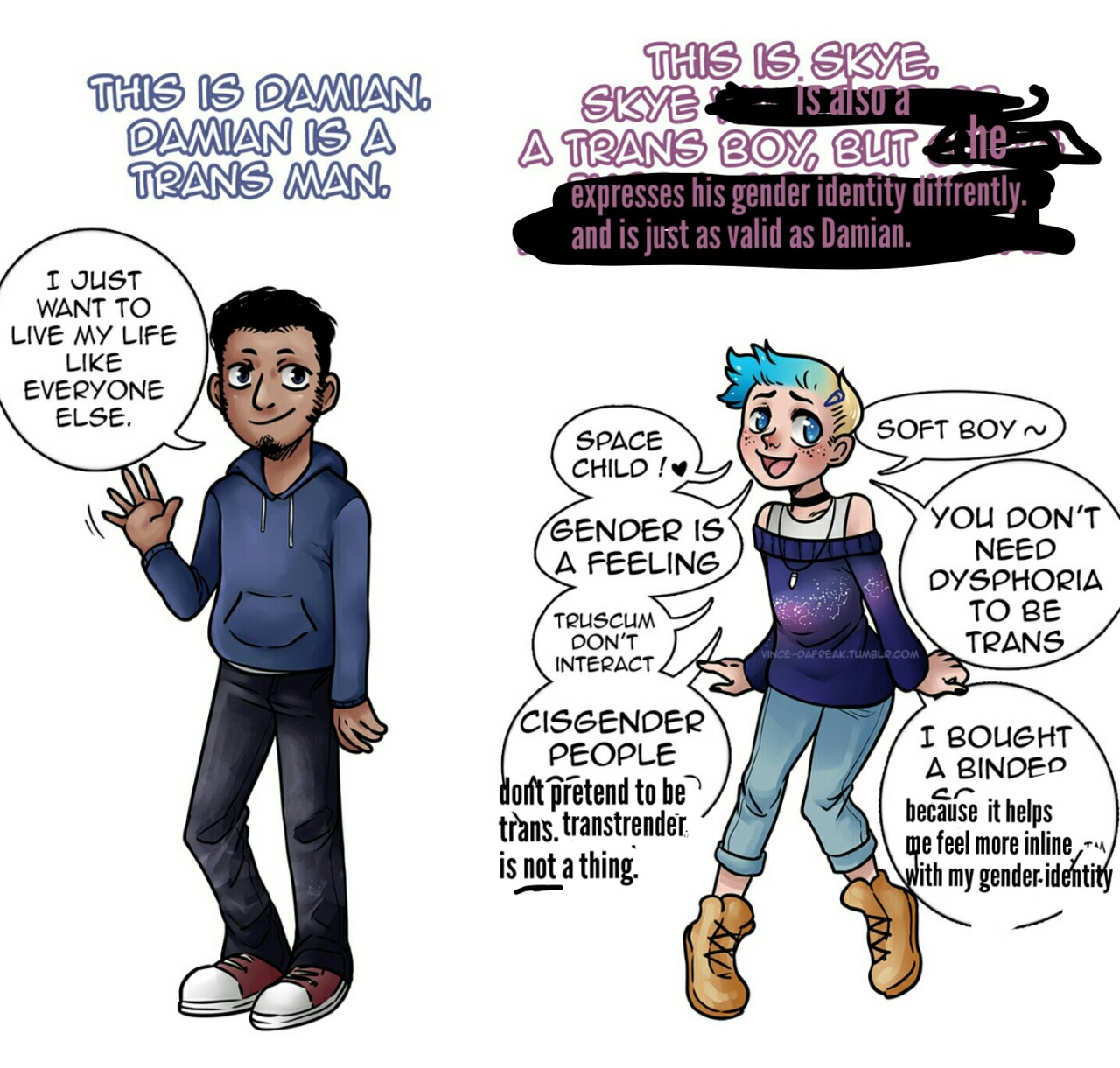
“Truscum/transmeds are the only ones who really care about trans people.”
Never mind that that’s not true; it’s outright manipulation of vulnerable people.
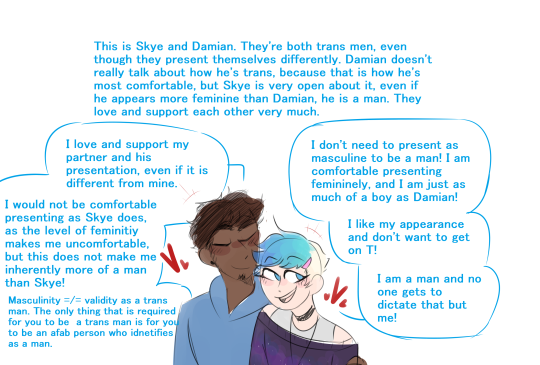
anyway, skye is a boy and i support him way fucking more than i would ever support truscum
I fixed it.
@vince-dafreak anyway you dont get to play god and decide peoples gender for them and you being a trans man doesnt give you authority over others peoples presentations and identities!
THANK YOU FOR FIXING THIS POST YOU’RE BLESSED
Truscums: wants you to hate yourself and kiss cis people’s asses
Trans people: want you to love yourself, dysphoric or little dysphoria
reblogging for the fixed editions.
Support all trans people. Not just the ones you think look right.
Not our job to decide what somone else’s gender identity is. It’s for them to decide.
This post has been improved 1000% since the first time I saw it
Not that dysphoria is necessary for being trans and also truscum can go fuck themselves, but even on their own terms the OP was saying Skye has dysphoria? I mean it literally says in the picture he got a binder.
Also this idea that being transgender has to be some kind of sickness or suffering seems transphobic of itself. Many trans people do have dysphoria, but being trans is not inherently some sort of curse, like wtf. Notice how OP says being cisgender is great but has nothing good to say about being transgender.
yeah basically. tho someone can have a binder without being dysphoric, sometimes, it’s a big hint. cuz that stuff is costy and hurts ur back lol u dont wear it for fun but for comfort, yeah.
and frankly dysphoria being caused by being misgendered and having our gender mocked and invalidated (by ppl like op, for example), it comes and goes. we’re not born with it but it happens to grow too often, and it doesn’t go away with transitionning like truscums love to lie about to reassure themselves. only self-love, and therapy when too serious, help.
nerdgul, seraph-s, you’re the real deals out here. the edit of the original image looks better than it, ffs.
and skye is basically saying the same thing as damian but with less words but okay.
et vince, ducon de mes pompes pourries, il serait temps d’arrêter d’être un lèche-cul fragile de la sofec, hein !!!
Good info, thank you. Also there’s the blatant gender role policing and cissexism in the op, like “you must be THIS masculine and also pass as cis to be a real man.” It’s such a mess on all levels.
Um? This is the woman who was confirmed, over and over again, to have put her ambitions ahead of the good of others, of Bajor, or indeed the universe. She also ummm tried to assassinate her opponent (Bareil)? Which would make anyone a villain? But that’s not close to all of it, you even brought up the pah wraiths yourself–i.e. her last arc in the show, where she was going to burn Bajor down and kill the Prophets because they liked Sisko better than her. I’m not sure what Berman meant by violation, certainly Dukat raped her by deception and no one deserves that. Here’s some news, though: suffering a wrong does not in itself make you a good person.
@kyberfox The salt of Dukat stans in response to his story is a major reason to love DS9 as a show, if not the fandom. But eeewwww in addition to presiding over genocide (like that’s not enough) Dukat is a sexual predator and a serial rapist and he has stans, wow. I don’t think his history of rape was as blatant in the earlier seasons though it was certainly implied, but even then he was creepy as hell pursuing Kira. Terrible as Winn is, I’d be hard-pressed to say she’s worse than Dukat and felt awful at how she was tricked by him. And that’s another long rant on how misogynistic the show was toward women who dared to enjoy sex.
@seguun Well, maybe. He certainly had flashier material, more expected material for a bad guy/protagonist’s rival. On the other hand, Winn’s brand of evil is more understated and also more… prosaic? I’d call her more corrupt than Dukat’s brand of out-and-out evil. Hers was a more nuanced look at corruption, not like Dukat’s which comes about more rarely through a perfect storm of power, policy, and personality–the sort of evil that doesn’t happen unless there is a severe power disparity, unless there is a decision to use that disparity for destructive exploitation, and unless there are (and there always are) abusive personalities to carry out that exploitation.
Winn’s brand of evil, or corruption, on the other hand, can happen in a broader range of situations. In fact, Dukat was at his most Winn-like when he turned internally toward Cardassia, as a self-serving politician, than when he was dealing externally with Bajor as a past colonial overlord. Like Winn, Dukat resisted foreign occupation, then supported/led a civilian government. These are positives as far as they go, but we also know that both Winn and Dukat were ultimately serving themselves. I can think of a lot of politicians who would be Dukats if given the chance, but in most situations they have to settle for being Winns. Dukat himself was more like Winn in Cardassia between withdrawal from Bajor and the Dominion takeover.
I think the banality of corruption is one reason some don’t see Winn as a villain and thought Dukat was being redeemed–because these characters were in the normal work of politics, whether in operating government domestically or fighting against foreign threats. The thing is, of course, they were using the workings of government to lift themselves up and serve their own ends at the expense of their peoples. Dukat again does the more obviously evil thing by giving Cardassia to the Dominion, but Winn, too, chose her advancement over the good of others and of Bajor throughout the show.
Their parallels are shown in their relationships with Sisko, too. Dukat may have hated and opposed Sisko openly while Winn was in a position where she had to give lip service to and be friendly with Sisko as the Emissary, but it’s clear from early on that she hates Sisko and thinks she deserves the love and reverence he gets.
It’s deeply fitting and satisfying then, that despite their differences, and indeed their enmity, Dukat and Winn end up at the same place at the end of Season 7–serving the pah-wraiths and destroying Bajor. One is an open racist and unrepentent genocidaire while the other is the spiritual leader of Bajor sworn to defend the world and its faith, yet they reach the same conclusion: Bajor, and the Prophets, deserve to be destroyed for not exalting and appreciating them enough. Dukat’s evil and Winn’s corruption may have taken different forms, but they were both equally destructive in the end and, indeed, Winn’s role was more crucial than Dukat’s.
Winn’s real final arc begins not when she is cruelly deceived and violated by the pah-wraiths and Dukat, but when she learns of the deception and responds to it. Rather than look back on her life and her faith and withdraw to make some much-needed changes in her life and heal from the spiritual and emotional trauma of what she was put through, she yet again decided power was more important and made the ultimate, fatal choice.
Winn’s story was different than Dukat’s, certainly, but in many ways I thought it was a more universal story with greater subtlety and nuance. I think together they made for a more rounded look at the nature of evil in politics.
one of my patients came in for an emergency visit, because she snapped the wire on her retainer watching the movie when MBJ took his shirt off she clenched her teeth so fucking hard she snapped it. that is the fucking funniest shit ever to me this tiny 17 year old girl thirsting so goddamn hard she busted steel
Characters: Young Erik Stevens/N’Jadaka, Zuri, T’Chaka, N’Jobu (deceased)
Summary: After T’Chaka kills his brother, Zuri makes a request that changes the course of Erik’s life.
Warnings: Character death, angst. An attempt was made at a happier Erik AU, but the start is inevitably dark. Also spoilers for the Black Panther movie, obviously.
“My king, he is dead.”
Zuri rose from where he had bent over N’Jobu’s body, and T’Chaka said nothing. He had not needed the confirmation and needed it, for without those words he would have stood rooted where he was and never moved.
His brother N’Jobu was dead. The words unblocked the flow of time and forced him to take the next step, then the next in this new world without feeling and without a brother.
“We must leave now.” His voice overflowed his tight throat. There was no pain, for he felt nothing.
“Your Majesty.”
“Come, Zuri. We must away before the local authorities arrive.” He turned his back on N’Jobu’s body. There was nothing more important in the world right now than to be away from this place, right now, before he was forced to feel again.
A body thudded to the floor behind him and T’Chaka only just kept himself from screaming, the sound too close to the memory of N’Jobu falling.
“I cannot go. Not alone.”
T’Chaka turned inch by inch, not letting himself look beyond Zuri’s prostrate form. “Our time is short.”
“Yes, and that is why you must leave now, sire. But I cannot, not without Erik. N’Jadaka. He has no one else.”
“Zuri, this is my order as your king. You will leave this place with me at once.”
Zuri raised his head, the tracks of recent tears shimmering on his face. “You gave your own brother’s life to save mine, and it belongs to you now more than ever. Do what you wish with it, my king, strike me down for my disobedience if it please you. I will not leave that orphaned child while I live.”
Or while you are conscious. T’Challa considered knocking Zuri out and taking him onto the transport. It would be easy, with the power of the Black Panther coursing through his veins.
Just as he could have done with N’Jobu.
Against his will his gaze was pulled from Zuri to the body that lay on the floor. He flexed his hands, which remembered the sensation of claws slipping into his brother’s chest. Why had he not punched N’Jobu instead, incapacitated him to go back to Wakanda and justice? Was it the cold-hot fire of rage that had whipped his claws out? Was it the heartrending cries of the Border Tribe child who had lost his parents?
“This is my order as your king and sovereign. You will return to Wakanda with me.”
“Your Majesty!”
“And you will bring the child.”
Zuri stared at him, absolutely still, not even breathing.
“Quickly, Zuri. I will take N’Jobu’s- I will take him to the transport. Find N’Jadaka and bring him at once.”
Zuri bowed his head down with such force it thumped on the floor, and T’Chaka winced in sympathy. Zuri rushed out the door with what T’Chaka could only assume was an aching head, and with his enhanced senses he heard the young shaman’s feet pound down the stairs.
What have I done? He looked down at N’Jobu’s face, peaceful now in the wake of the rage that had consumed him in life. And what did I almost do?
He put on his helmet, putting that barrier between himself and the world. He gathered N’Jobu into his arms, the weight of his little brother bringing back memories of a drunken trip back home after the rain fest.
Lulama and Sisipho, his Dora Milaje attendants, greeted him at the top of the building where the royal transport awaited. If they were shocked at the sight of him carrying N’Jobu, they were too well-trained to show it. He refused their offer to take his burden from him, the weight of him a comfort now that kept him from floating far away into unknown skies. He could think for a moment that his brother was unconscious. He would wake up and they would talk again, for how could it be otherwise?
He had just laid out N’Jobu in the ship’s infirmary when he heard two other footfalls, one an adult’s, the other a child’s. He came out to meet them and faltered at the sight of the boy.
“Uncle James, where’s Dad?” The child who must be Erik looked around at the sleek interior of the ship like a bewildered antelope. He fell silent when he caught sight of T’Chaka’s armored form.
In the few steps he took toward the child T’Chaka walked through an ocean of memories, looking down at his baby brother in his mother’s arms, the wind blowing through his hair as they spurred their horses down the border plains, splashing in the shining threads of the river.
My brother, I have lost you…
He knelt before N’Jadaka, son of N’Jobu his brother who was gone now to the ancestors, to face their justice or welcome.
“Erik.” Zuri placed his hand on the boy’s shoulder. “This is His Majesty T’Chaka, the Black Panther and the King of Wakanda.”
“Uncle James?” The boy looked up sideways at Zuri but stood his ground. A cautious and intelligent child, thought T’Chaka, yet brave.
“I am your father’s brother.” He met his nephew’s eyes through the visor of his helmet, not trusting himself yet to compose his face. “The enemies of Wakanda have harmed your father, but you are safe with us. You will grow up in Wakanda with my children, T’Challa and Shuri, and I will raise you as my own.”
“Harmed my… where’s my dad?” The child’s voice rose in panic.
T’Chaka stood. “Lulu, escort Prince N’Jadaka to the infirmary. Zuri, go with them. Sisi, with me.”
He strode to the cockpit as though to keep ahead of the wails that would rise behind him, the sound of a child made an orphan at his hands.
“Set a course for home.”
Home, to Wakanda so beautiful and so aloof from the world. Wakanda that he had given a brother’s life for. Wakanda where he would bury his flesh and blood. Wakanda where he would raise N’Jobu’s child, and teeter on the edge of truth and lies through the years, and know pain and joy and pride and not an hour of peace.
“Take us to Wakanda.” The tears flowed at last behind his mask of star-steel, and the hum of the engines lifting them into the sky almost covered the screams of a bereaved child.







 L.J.'s Obsessions