I had been seeing a therapist a few months ago, due to my C-PTSD, depression and childhood trauma. During that time, I had been struggling with finding a job because of my condition, and whenever I was able to apply to a very hopeful job with a good salary, my therapist appeared very skeptical and against it. I couldn’t understand why. She would suggest that I apply to Walmart instead of the types of jobs I had been applying to. I didn’t catch on, right away, of what she was really implying, and she just kept suggesting walmart. Every week when I updated her on my job search, she’d ask:
“Well, have you tried Walmart? What about Walmart? You’ll be able to get a nice apartment and live on your own if you do Walmart.“ I would just look at her, baffled as to why in the bloody hell would she think that a part-time position at Walmart would get me a nice apartment AND pay the bills in southern California… The thing about that, though, is that I wasn’t seeing through what the ole’ bitch really meant.
During one session I complained to her about how my panic attacks and nightmares were getting worse ( I didn’t realize that she was the cause). Her response to that was to give me a worksheet called “Monkey Trap,” about a metaphorical monkey getting its hand stuck in a jar. It had absolutely nothing to do with what I had originally complained about. I still didn’t catch on right away, but the nature of my depression and c-ptsd makes it very hard for me to spot abuse right away,( and you can easily look this up in case anyone wants to shame me for not seeing her for who she really was right off the bat), plus it was my first time in therapy, so I didn’t know what to expect.
Then, she started to completely ignore and scoff at the idea of me having PTSD/C-PTSD. She didn’t want to acknowledge it. I would try to explain my childhood trauma, and she’d tell me to get over it. Her reason for this?
“You are a strong black woman! Don’t try to make me believe that you can’t handle abuse! It’s nothing to you!"
That’s right. She said it. This disgusting woman was denying me the proper mental health treatment because of her racist idea that "strong black women” don’t feel pain, can’t experience trauma and no way could develop PTSD. “Black women don’t usually have PTSD,” according to her…
I have notified my health care provider, insurance, and complained to the BoP about this woman. I just want everyone who might be seeking mental health care to be careful and research a counselor/therapist before you see them. If anything feels off, get out! If they seem indifferent, get out! If they try to shush you and do not want to listen, get out! Since it was my first time, I didn’t do any of that, but I’m here to tell you that if it is your first time in therapy, please be aware of this. Research before you go in. Have an initial consultation. If they violate your mental health in any way, report them to your Provider or the Board.
But don’t worry, most writers are and I’m here to help because reading them is making me cRAzY.
I’m writing this because I’ve read three otherwise great romance novels back to back featuring characters dealing with PTSD (or PTSD symptoms) and each one of them made the same dream mistakes. I honestly can’t think of a fiction book I’ve read that didn’t make these mistakes, so I thought I’d compile a handy dandy list of mistakes and how to fix them.
Lucky for you, I have PTSD and a ton of fellow veteran friends who deal with these symptoms.
*This is based on my experience and things told to me by friends. This is not to say that the below doesn’t happen in real life, only that it’s not as common as you might think.
The issue with these dreams is twofold: on one side is the psychological accuracy of the dream and on the other side is how you’re using the dream within the narrative.
Oh an Black Sails spoilers-ish ahead.
1) Stop writing the dream as a shot-by-shot accurate retelling of Traumatic Event.
Listen, not only do dreams seldom follow reality, but our own memories are tricky at best. I don’t remember getting beaten up because a) it was horrifying and we block stuff like that out and b) I was going in and out of consciousness. It would be pretty strange for me to dream something I don’t even fully remember. Our brains are simply not wired to do these vivid factually-accurate cinematic retellings.
My friend dreams things that did happen, but in his own words those dreams are always wrong in some noticeable or bizarre way. For instance, he’s getting chased through the streets of Iraq by a werewolf.
2) Dreams are informed by reality, not direct reflections of it.
It’s entirely likely my friend dreamt of a werewolf in Iraq because I got him binge watching Supernatural and the two ideas merged in his dreamstate. But see, that’s how dreams work.
The trauma event exists as a constant in his subconscious, but he has all this other information right there in his conscious mind all day, every day. In dreams, there isn’t a clear delineation between that information.
My dreams are often dependent on whatever I’ve fallen asleep watching on television. The themes are consistent, but not the content.
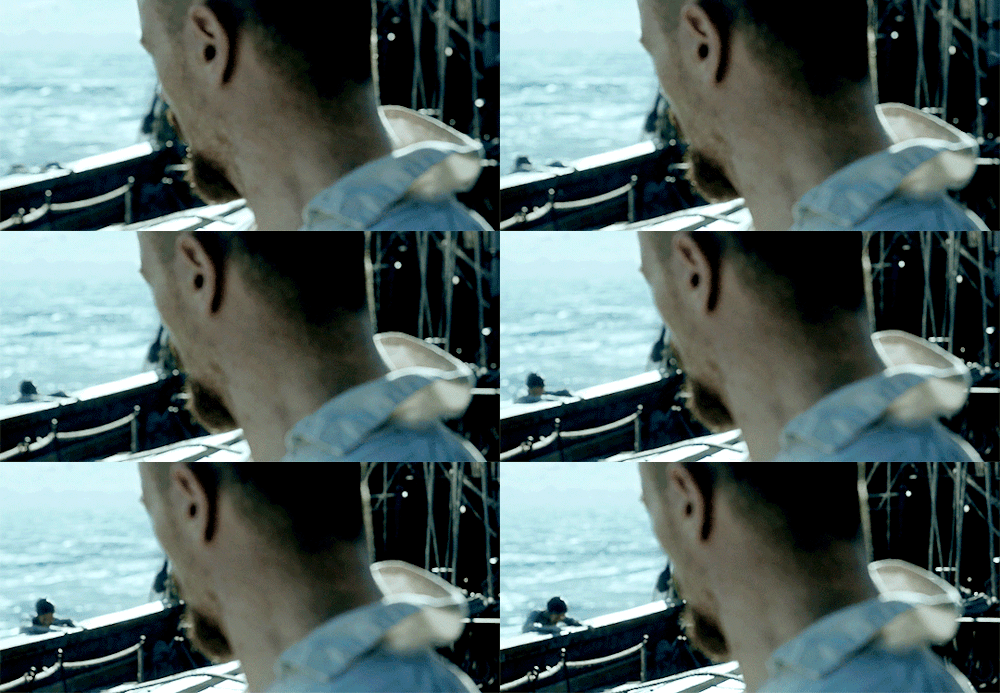
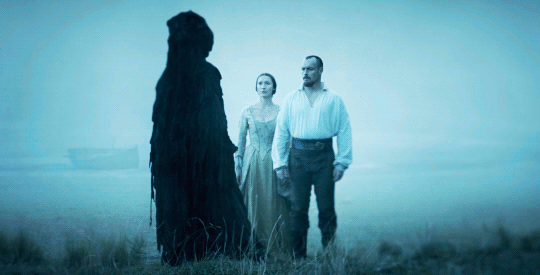
In Black Sails, Captain Flint’s trauma dreams feature his dead partner and friend following him around his empty ship. You have an element of the trauma (the animated corpse of his friend) + his daily existence (his ship). The two things intersect to form these unsettling nightmares as expressions of his fears and grief. He never once relives the event itself in his dreams as shown on screen.
Speaking of…
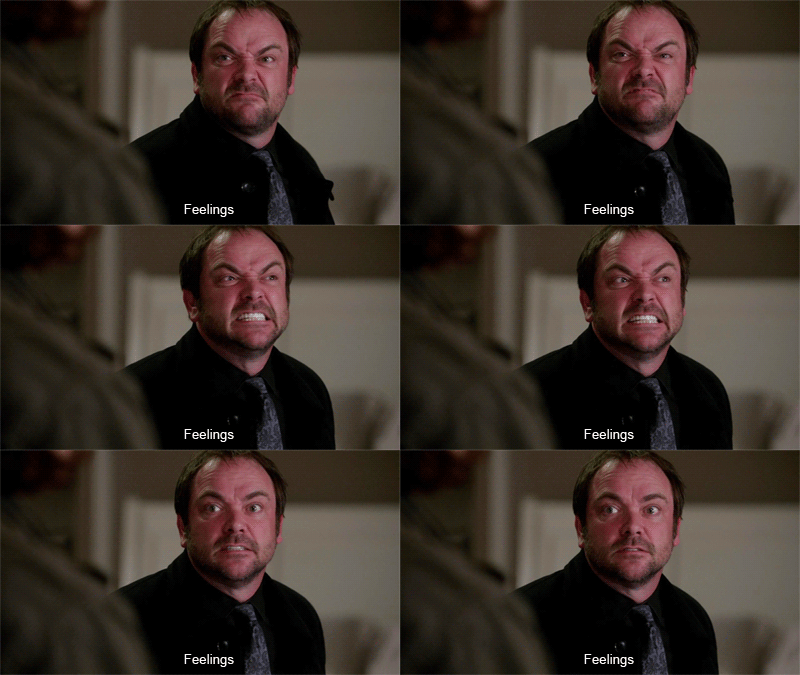
3) Trauma dreams often revolve around feelings, not necessarily the events themselves.
The PTSD package generally includes heaps of shame, guilt, anger and fear. As someone who survived a beating when I should have had control of the situation, my dreams tend to revolve around fear that people will know I’m a fraud or being unable to act in a dangerous situation.
Again, it’s entirely common for trauma victims to not remember large chunks (or the whole thing) of the trauma event. So why should their dreams be stunningly accurate? What we remember are feelings. Real strong feelings.
You cannot go wrong if you write your trauma dream around feelings, not a specific event.
4) If you present trauma dreams as expressions of themes, you can let go of the trauma dream as an exposition dump/way overused suspense trope.
You know you’ve read this: MC has dreams that are a shot-by-shot retelling of Traumatic Event that always cut off right before Traumatic Event, so that the Big Reveal must happen by a discovery later in the novel.
If I were the MC in a book, the easy and common thing would be to use the “dream sequence” as an expository retelling of Traumatic Event as a way to give some backstory to why I might be surly, mistrustful, afraid to try something new, whatever, and to clumsily shoehorn in suspense where there doesn’t need to be.
The much more interesting thing might be if my dreams were inconsistent in content but consistent in theme. In one I’m on an alien planet (because I fell asleep watching the Science Channel again) and the ground opens up and I fall into a pit from which I can’t escape because I am helpless. In another a man is watching me while I sleep where I am again frozen and helpless. This would force the reader to think: what is the recurring issue in these dreams? Why is it important? What is this telling me about this character and what happened to her?
It could be a personal preference, but I’d rather see the Traumatic Event either told in narrative flashbacks (not dreams) or verbally retold by the character in question. Let the dreams tell me something deeper about the character. It’s not that I was beat up, it’s that I feel like a failure because of it. One of these things is a shallow factual detail, the other tells you something about me as a person that I’m sharing with you, gentle reader, because talking about this stuff is healthy.
5) The Traumatic Event doesn’t have to be a big secret.
In Black Sails, we know what happened to Captain Flint’s partner. It happened in real time in the show. That didn’t make his uber disturbing dreams less disturbing or mysterious. Fans still debate exactly what the symbolism was and what they were telling us about James Flint in those moments. We do know from the dreams that he was disturbed, obsessed, and also monumentally guilty and blaming himself for what happened.
The mystery was perhaps more heightened by the fact that the dreams weren’t direct reflections of reality. We know who this person was, what she believed, and why she died. That Flint is imagining her screaming silently in his ear is horrifying and discordant with what we know to be factual. This adds emotional complexity to his character and the decisions he’s making while suffering these dreams.
^^^this didn’t happen. It was a dream. A real unsettling dream.
Once you let go of the concept of the trauma dream as a literal retelling and exposition dump, you have the entire dreamscape to work in other narrative elements, like symbolism, metaphor, foreshadowing, etc.
i know y’all don’t want to hear this but coping mechanisms aren’t inherently healthy and just because it helps you in the moment doesn’t mean it won’t hurt you in the long run
when people tell you your coping mechanism is unhealthy they aren’t trying to police you or tell you what to do, they’re pointing out that you are hurting yourself and possibly hurting others and that you should find better ways to work through your trauma to have a better outcome in life
listen if this post makes you mad, I’m sorry, but i made this as someone who is mentally ill, as someone who is an abuse victim who has and still uses unhealthy coping mechanisms because people on this website discouraged me from seeking help
it’s hard to recognize youre hurting yourself. it’s hard to break out of that. im just tired of the prominent anti-recovery rhetoric on tumblr dot com and a lot of others are too.
Good post here.
And for anyone who missed it the first time reading, like I did: inherently is an important word there. There is such thing as healthy coping mechanisms. They exist. But there’s also such thing as unhealthy coping mechanisms, and you need to figure out which one is which if you want to better yourself.
It does get tiring at times staying conscious of bigoted tropes in fandom, deciding not to support racist art, wondering if a quote is appropriative of Jewish experiences, discarding a homophobic fanwork idea, and more.
So as a Fandom Old I can see why some fans long for the “good old days.” Back then anything went! Total creative freedom! We were wild and unfettered! None of these long-winded discussions, we just went and did it and did not give a single fuck!
Except freedom wasn’t for everyone, was it? You only had that total freedom if you were unaffected by fandom’s racism, homophobia, transphobia, antisemitism, ableism, and a host of other bigotries that are a reflection of the world we live in.
Fandom was never the carefree, escapist enterprise some of us like to think it was. It’s just that minority fans were bearing the load of others’ freedom in silence. Too often, fans who were marginalized in real life could not escape to fandom because fandom would uncritically celebrate their oppression and trauma. And if they dared to speak about it they were bullied and shouted down into silence, into leaving.
I speak in the past tense but this is still ongoing, obviously. Fans of marginalized identities are a little more vocal now, but are facing a sustained and vicious backlash that accuses them of being “bullies” and starting “discourse” and “drama” and of “virtue signalling.”
It’s not about discourse or virtue, though. It’s about fans being told that they are not welcome unless they bite their tongues, grin, and go along with a thousand stings and slaps in the very spaces they go to have fun. It’s about fans having to watch characters who look like them be constantly erased and demonized. It’s about fans having to spend endless amounts of time and energy educating other fans about their oppression when all they’d like to do is unwind after a long day made longer by those very issues.
It’s not about virtue. It’s about people.
The thing is, fans who criticize minority fans and their allies for “discourse” aren’t angry about the fact that fandom puts these psychological burdens on minority fans. They’re mad about having to share a tiny little part of the burden minority fans, most visibly Black women, have been carrying for too long. In the minds of these “discourse”-critical fans the burden of considering the impact of fandom and fanworks is not theirs to bear. It is the lot of fans who are not them, “others,” to pay the cost for the majority’s creative freedom. The very suggestion that the load exists, and worse, that all of fandom should share in it so marginalized fans don’t carry it so disproportionately, is enough to make a lot of fans uncomfortable. I know, because I feel that discomfort at times, too.
The thing is, the load of thinking about marginalization in fandom spaces was always mine to bear. It’s every fan’s responsibility to be conscious of how they create and consume fanwork so that they don’t hurt other fans, so fandom can be inclusive and fun for everyone.
No, it’s not pleasant. It’s not fun to always watch yourself and second guess your choices, to fall short anyway and be called out and confront the fact that you have so many unconscious biases and have hurt others. I get it. I do. I want to think of myself as a good person. I don’t like admitting to wrongdoing. I hate challenging myself. I don’t want to think about this hard stuff. I just want to have fun!
But think about how much LESS fun it is when it’s your own humanity on the line. Many marginalized fans don’t have the luxury of just letting go and having fun, not when they always have to brace themselves for the next psychological assault.
These fans have been carrying this fandom burden and are punished for saying it’s too heavy. If you’re feeling a little less feather light in fannish activities than you used to, that’s a good sign! It means you’re starting to carry, in a very small measure, the fandom load of consciousness. It’s something you should be carrying as part of a community, and chances are it’s still not nearly as heavy a load as many marginalized fans are still made to bear.
A community joins together, watches out for its members, shares in the good and the bad. If some members are asked to bear the costs of others’ fun and either stay silent about it or leave, then the promise of community rings pretty hollow, doesn’t it? Sometimes discomfort is a good thing, and if my small discomfort means I am sharing in a tiny measure of my rightful load in fandom spaces, then it is a very good thing indeed.
Then there’s the part where it intersects with people using problematic tropes to cope tho
a) coping methods are not above criticism, especially if they’re harmful to others.
b) coping methods aren’t inherently good or moral or healthy. there are many, many, many examples proving just the opposite.
c) cope shipping, specifically romanticizing abuse/rape/pedophelia, can be not only regressive a coping method, but can be retraumitizing as well. as such, they should be brought up in a therapy setting, not on tumblr.
d) most of these marginalized folks have their own traumas or things to cope with, but all y’all seem to forget about that when you want to justify your racism or transphobia or antisemitism.
1. I’m unable to articulate why but I really feel like I’m being talked down to here as if you were kinda done talking before even replying so it feels like you’re just trying to get me to shut up. But I won’t, because I tend to get told I overthink things so I don’t want to assume…plus it’d be pointless to stop before I come to an understanding other than “wow this person is intimidating” on a social media site, talking about social issues. Like that’d just be some cruel irony
2. Therapy is expensive, exhausting, and really requires a lot of maturity and self-reflection that most people aren’t ready to face at any old point in time. Coping mechanisms aren’t a means of healing, they’re a sort of bandaid to keep yourself from doing more serious self-harm…so it’s inappropriate to compare it to therapy as if you can switch one for the other on a dime
3. I understand no one solution is workable for everyone, even the concept of some people’s coping mechanisms worsens my mental health just being aware that they exist. But then what about tag filtering? Readmores? Content warnings? Heck, even a disclaimer.
4. I know that positive representation for minorities are actively oppressed… But does the answer to that really have to be forcing all the independent creators who rarely are paid fairly for their work, if at all, to take like several online courses in social issues and different cultures before being allowed to create anything?
I guess you’ve heard all this shit before. I been on here trying to learn for 4 years and this stuff still confuses and upsets me so much. I’m just…not good at reading and absorbing this kinda stuff properly, so I apologise for that
You’re derailing the conversation. Every time someone speaks up about marginalization in fandom, someone jumps in with “people use it to cope tho.”
Marginalized fans immerse themselves in fandom to cope too. The very common suggestion that we have to curb ourselves because of “coping” is saying that the pain of a fan who writes slavefic to cope is more important than the pain of the fan who experiences systemic discrimination because they are a descendent of slavery. Fandom worries more if fans who enjoy the woobification of Nazi metaphors feel bad because of “discourse” than if the popularity of the cuddly fascist makes fans feel unsafe.
If coping gives a fan the right to do or say whatever they want regardless of the feelings of others, why do the feelings of others suddenly matter so much when people talk about tropes that are harmful to them, fetishization, and racial marginalization?
And literally no one is saying fan creators have to take courses in cultural issues before creating content. But listening to criticism from otherized people goes a long way. It’s often more educational than an online course.
Yep. Every single time someone talks about fandom racism and racist bias in fandom someone always feels the need to jump in with their whitesplaining (and yeah, one doesn’t necessarily need to be white to whitesplain) to derail and shut down the conversation about fandom racism.
I’m tired of “it’s a coping mechanism” being used as a blanket excuse to cover every ill. You can’t say “it’s a coping mechanism” and then pretend that means you’re above all criticism and that no one is allowed to question it or pick it apart. You can’t use it as a shield and then fire back at people for “attacking” you when they do point out the flaws in your thinking. And as stated above, you don’t have some kind of moral high ground when your “coping mechanism” causes additional trauma to others.
I get that having your trauma ignored, marginalized, or unrecognized can be damaging and yes, of course you have the right to try and deal with what was done to you in a way that works for you… as long as it doesn’t hurt others at the same time. And TBH if you know what it’s like to have your own ordeals ignored I would hope that would make you more understanding/accepting of the ordeals of others rather than flat-out telling them that your trauma is more important than theirs.
Also, since this post is focusing on the ingrained racism in fandom, I’m a little bemused at the idea that overt racism in fics, the uncritical stereotyping of characters of color, and the vilification of nonwhite heroic characters in order to make white villains look good is somehow meant to be acceptable and unquestionable because “coping mechanism.” That… that isn’t how it works. That isn’t how ANY of this works. Especially when you’re white and you’re actively demonizing or otherwise degrading characters of color. No “coping method” is above critical examination and if people are telling you that what you’re doing to cope is hurting them then one of the people engaging in that critical examination should be YOU. Instead of getting offended or making excuses or accusing others of hurting you, maybe you should take a good hard look at what you’re doing and ask yourself WHY? And then figure out if there are less damaging ways to accomplish what you need to do. I’m all for a bit of “sometimes my needs should come first” thinking, but you don’t exist in a vacuum and your needs shouldn’t actively hurt others. Racism as a “coping method” is a very slippery slope, especially if what you’re doing is enforcing it rather than taking it apart and trying to find ways to improve yourself/recover from it. And again if you’re a white person claiming that racism is a big traumatic issue for you it’s something you should be giving a lot of thought to before going on the offensive against people for whom racism is a daily fact of existence.
Some people?? Are racist?? To cope???
Yeah, kinda horrifying that people honestly believe that, huh? I call it a “slippery slope” but it’s a slope greased in bullshit and leads straight into the spike pit of “you’re a fucking racist and can’t even admit it.”
I like the analogy of “it’s a coping method” being the equivalent of “it’s just a joke” because yeah, that’s exactly how it gets used. It’s a way of deflecting responsibility and critical thought and it speaks of rank amounts of privilege. Not everyone who claims to have a coping method is misusing the term, but when it comes to making excuses for racism? Yeah, that doesn’t cut it.
Exactly! And like I was mumbling in the tags, I don’t think it’s a coincidence that the “coping” line smacks so much of the way white female fragility is weaponized elsewhere. Mental health gets brought up all the time as a derailment and deflection to fandom racism discussions, from anxiety to coping to even suicidal ideation. (Yup, in case you haven’t seen it, white fans and writers have said that accusations of racism make them suicidal.)
Because evidently, mental health is the sole preserve of white fans and fans that agree with them. Because evidently, racism can’t cause or worsen mental illness, or make people suicidal. Hey, it’s not like being exposed to racism has been associated with cardiovascular conditions, which may be one reason for lifespan disparities between racial groups! It’s funny how health is such a one-way street in these discussions and some people’s health seems to matter more than others’.


 L.J.'s Obsessions