Leia! Organa! Solooo!

falconlord5:

I was going to write about Finn today, but you guys were talking shit so I figured I needed to lay down an intellectual beat down.

Join me under the cut!

더 보기

I like this! It’s strikes a good balance of acknowledging Leia’s faults and possible mistakes while emphasizing that Kylo is firmly responsible for his own actions–and in fact would be boring as hell if he weren’t.

On Kylo Ren and Leia’s confrontation, though, you seem to contradict yourself: on the one hand, that Rian changed nothing from a story where Leia was supposed to wrap up her arc in the next movie, and on the other that they would have found some way to wrap up Leia’s arc by including the confrontation. The first statement seems to indicate the confrontation was left to Episode IX (and thus will never happen), while the second assertion is that the confrontation will come in TLJ. What am I missing here?

aimmyarrowshigh:

jewish-mccoy:

just a not so friendly reminder that both Kylo’s parents are jewish so uh?? maybe consider that idk before you call him a nazi since he’s coded jewish 

A not-so-friendly “hey, you’re absolutely wrong, and I’m a Jewish SW fan who calls him a Nazi ABSOLUTELY FOR A REASON AND THAT REASON IS HE’S MEANT TO BE SEEN AS ONE” –

An integral part of Kylo’s entire storyline as a villain is that he is
ethnically Alderaanian (Space Sephardi Jewish, as far as current canon
can be compared to real-life ethnic and cultural groups) and raised by a
mother who both witnessed the genocide of the Alderaanian people AND
had the responsibility of representing their culture on the Galactic
stage so that their presence wouldn’t be forgotten entirely after the (lowercase-h)
holocaust…

But then he, as an adult man, of his own free will, CHOSE
to reject his heritage and join an explicitly neo-Nazi-coded fascist
military/political junta that existed solely to finish the ethnoracial
cleansing the Empire started in the Galaxy and centralize power under
one tyrannical leader who believes that only human beings (all white, in
the films, although there are some Black FO officers in the
novels/comics) is fit to have independent autonomy. The First Order is
literally called The First Order because “the first order of business is begin [the Empire’s reign] again.”

One of the first acts of the FO/final acts of the Empire was to hunt
down and exterminate all surviving Alderaanians, illustrating that it
was NOT solely a political decision on Tarkin’s part – it wasn’t about getting Leia to reveal where the Rebellion HQ was; he was always going to destroy Alderaan because its culture and governing body were antithetical to the Empire’s ideals and goals and Tarkin himself HATED Alderaan and Alderaanians. (In fact, a lot of the antisemitic stereotypes neo-Nazis and antisemites associate with Jews IRL are traits that Tarkin ascribes to Leia, Breha, and Bail, particularly in that he thinks that they’re manipulative wealth-hoarders who have a secret agenda to take over the Galaxy for their own gain [which, of course, is fucking rich coming from a Grand Moff of the Empire, analogous, of course, to a rank of Reich Minister.])

Further, Kylo Ren chooses, as an adult man, of his own free will, to reject his Alderaanian heritage EXPLICITLY BECAUSE HE IS GIVEN A REASON TO BE ABLE TO SHED THAT IDENTITY. He joins the First Order – again, an OVERTLY neo-Nazis-coded illegal fascist junta, in the movie, which IDK if you saw, but is very overtly coded as a neo-Nazi regime – because he finds out that he isn’t actually the biological grandson of Bail Antilles and Breha Organa of Alderaan, but of Anakin Skywalker/Darth Vader. He was not raised as Vader’s OR Anakin’s grandson, but as the grandson of the Organas – he joins the FO very shortly after a statue commemorating the Alderaanian Genocide is erected at the New Republic Senate building (which, btw, Kylo helps to destroy in the FO’s OWN genocide in TFA, because it’s on Hosnian Prime). He violently rejects his Space Jewish identity, and he joins the First Order to prove it.

Honestly, did you watch TFA? Have you read the extended canon materials? I honestly have no idea what the fuck Rian Johnson is doing with his Kylo/FO apologism boner, but Abrams (a Jewish director and writer) and the Kasdans (also Jewish Lucasfilm writers and producers) went out of their way to make the parallels between the First Order/Empire and the Nazis/neo-Nazi movements as nail-on-the-head obvious as they could without literally renaming them. (Someone on here once pointed out that Armitage Hux, the FO’s screamy speechifying figurehead general, even has the initials “A.H.”) Abrams doubled down on making sure that the “Kylo Ren is exulting in being able to disconnect from the Alderaanian genocide” thing by having him KEEP HUMAN ASHES AS A TROPHY, which is OBVIOUSLY rooted in Shoah imagery even if it’s a grandiose departure from reality. (It’s a movie, so of course it is.)

Beyond the fact that their jackbooted stormtroopers are LITERALLY CALLED “stormtroopers,” their film presence as universally White in the upper echelons of power – the dynamics of Rae Sloane, and why she is no longer a part of the FO’s power structure, are something I hope Lucasfilm can explain well, tbh – and Space Racist (their core belief, beyond the radically conservative “central seat of power” form of government they originally advocated for, is that only humans should have power in the Galaxy, as I said above, which is a SUPER common scifi trope for racism), and the fact that Abrams and Kasdan and Lucas have all SAID that they’re meant to be Nazi allegories, there’s the whole “Hux’s FO speech was meant to mirror the Nuremberg Rally, visually and in content” thing, and it succeeds.

Like, basically, Kylo’s parents both being played by Jewish actors – although Driver is not – and Leia and Han being Jewish-coded characters is PART OF Kylo’s characterization as a neo-Nazi. His internal struggle, the Light versus the Dark, his pain of being torn apart, is an extreme hatred of himself. A big part of his canonical anger at his parents is that they never told him that he was not actually genetically Alderaanian, but was raised that way anyway. It’s… like, it’s very much an intentional choice.

I agree with most of your posts, @jewish-mccoy, but you’re not correct on this hot take. Maybe stick to Star Trek meta?

maybe-this-time:

Everyone always wants to talk about Hook or Pan. Everyone always wants to debate which one is good and which is evil – who we’re supposed to follow and who we aren’t. The Peter Pan mythos has pretty much shrunk down to nothing but Hook and Pan (Hook, SyFy’s Neverland, Pan, OUAT, etc). Occasionally Tinkerbell factors in (Hook, Disney’s Tinkerbell, OUAT, etc). There’s one character, however, that always gets sidelined – which is puzzling since they are the main character of both the play and the book. That character is, of course, Wendy Darling.

Peter Pan is Wendy’s coming of age story. Wendy who decides to run away from home. Wendy who realizes that she must grow up – and that there’s no shame in that. Wendy who sees Peter as deficient and sees Hook as empty and decides that, no, she doesn’t want to be a part of that. Wendy gets the adventure she’s always wanted and she turns away because she realizes that it’s lacking. She’s the only one who truly sees the hollowness of being young forever. Barrie even says “You need not be sorry for her. She was one of the kind that likes to grow up. In the end she grew up of her own free will a day quicker than other girls.”

People always debate on who the hero is. When they learn that Peter could be horrid they assume it has to be Hook. Of course, the answer is that neither of them are the hero. Wendy is the hero of the story. You’re not supposed to be like Peter, who kept every good and bad aspects of being a child and can’t tell right from wrong. You’re not supposed to be Hook, either. He let go of everything childish and loving about him and became bitter and evil. They’re both the extreme ends of the scale. You’re supposed to fall in the middle, to hold onto the things about childhood that make it beautiful – the wonder, the imagination, the innocence – while still growing up and learning morality and responsibility. You’re not supposed to be Hook. You’re not supposed to be Peter Pan.

You’re supposed to be Wendy Darling. 

The trouble with the Light Side, and Finn as the Balance

lj-writes:

What happens when you’re told, “Don’t think about the elephant?” Chances are, you’ll immediately think of an elephant.

I think that’s the problem with the Light Side of the Force as we have known it: So many of the doctrines and practices of the LS, such as the Old Jedi way of not forming attachments, are premised on resisting the temptations of the Dark Side.

If your goal is not to  turn Dark, then what are you going to be thinking about? The Dark Side. This is why puritanism of all stripes is destined to fail, because it’s consumed more with what it’s against (sex! rock ‘n roll! murder!) than what it’s for (eh, love and peace I guess?).

Anakin Skywalker’s story from the prequel trilogy is a prime example of this in the Star Wars saga, walking into the one place you were determined not to go. Intentionally or not, the prequels were an indictment of the Jedi way.

I think similarly, trying not to turn to the Light Side has a polarizing effect on those who turn to the Dark Side of the Force. You can see this with Kylo Ren in the new trilogy, thinking too hard about how not to go Light and then running to bugfucking extremes in the other direction.

The results of such extremism, in turn, are so horrific that the other side becomes understandably all the more preoccupied with, you know, NOT BEING THAT HELL NO and, again, being more anti-Dark than anything else. This doesn’t make the LS morally equivalent to the DS, but it does mean that LS practitioners can fall into the trap of puritanism.

Going to extremes seems to be a major theme of the upcoming movie, The Last Jedi, and Adam Driver who plays Kylo Ren has discussed mass murder committed by “both sides” (maybe this is his character’s perspective, I don’t agree with it) and how he took inspiration from the absolute moral certainty of terrorists in playing his character. As director Rian Johnson has repeatedly said the movie will showcase moral ambiguity, it’s a safe bet that we’ll see the good guys go to extremes, too, something we have also seen in Rogue One.

We can reliably tell where many of the characters old and new fit into this increasingly polarized galaxy: Leia, Poe, Holdo, Rose, Paige, and others on one side, Snoke, Kylo Ren, Phasma, and Hux on the other.

Other characters, on the other hand, stand in notable contrast to the characters whose allegiances are well known. Luke, the character we thought was the Rebel to end all Rebels and the Jediest of them all, not only stayed away for years but still seems reluctant to join the fight. Rey is definitely Resistance-allied, but is still trying to find her place in all this.  “DJ,” a new character, is a cynical outsider who’s only in it for the creds.

Then there’s Finn, who has been in and rejected the First Order and fought alongside the Resistance, but as of the beginning of TLJ is not a committed fighter. Like Luke, he’s wounded from past experience; like Rey, he’s still figuring himself out after his life was turned upside down; and like DJ, he is cynical of causes in general, something I have previously discussed.

In a universe of absolutes Finn stands out with the other uncommitted characters for his refusal, at first, to choose a side. Turning against the First Order does not mean he automatically chose the Resistance, though he has worked with them.

Interestingly, for someone who rejected absolute evil he seems to have very little to prove. He’s not obsessed with trying not to be evil, or with trying to be good by fighting evil. He suffers the undeserved shame of the abused, but he’s not consumed by it. He doesn’t beat himself up over killing Stormtroopers to defend himself or wonder if that makes him as bad as them, a lack of self-flagellation that some fans have criticized him for. He doesn’t agonize over whether he might be a bad person for lying to the Resistance so he could go back for Rey.

Finn is, in other words, the opposite of a puritan. He refuses to do evil, and that’s enough. He’s not consumed by the thought of it. He tries to be good to the people he meets and distrusts causes and grand theories.

Finn is most definitely not Dark Side, but he’s also not the Light Side as we’ve come to understand it, an anti-Dark puritanism. He allegiance, I believe, is to the Balance as near as I understand it, a goodness that is defined by what it supports, not what it opposes, a space that has room for human ambiguity and fallibility without fear of turning to irrevocable evil.

It’s significant to me that right after his arguably most morally questionable and admirably badass decision was revealed–that he had lied to the Resistance to come get Rey–Finn immediately brings up tho Force to a livid Han.

더 보기

For @swrebelfinn because the tags are acting up again ;_____;

The trouble with the Light Side, and Finn as the Balance

What happens when you’re told, “Don’t think about the elephant?” Chances are, you’ll immediately think of an elephant.

I think that’s the problem with the Light Side of the Force as we have known it: So many of the doctrines and practices of the LS, such as the Old Jedi way of not forming attachments, are premised on resisting the temptations of the Dark Side.

If your goal is not to  turn Dark, then what are you going to be thinking about? The Dark Side. This is why puritanism of all stripes is destined to fail, because it’s consumed more with what it’s against (sex! rock ‘n roll! murder!) than what it’s for (eh, love and peace I guess?).

Anakin Skywalker’s story from the prequel trilogy is a prime example of this in the Star Wars saga, walking backwards into the one place you were determined not to go. Intentionally or not, the prequels were an indictment of the Jedi way.

I think similarly, trying not to turn to the Light Side has a polarizing effect on those who turn to the Dark Side of the Force. You can see this with Kylo Ren in the new trilogy, thinking too hard about how not to go Light and then running to bugfucking extremes in the other direction.

The results of such extremism, in turn, are so horrific that the other side becomes understandably all the more preoccupied with, you know, NOT BEING THAT HELL NO and, again, being more anti-Dark than anything else. This doesn’t make the LS morally equivalent to the DS, but it does mean that LS practitioners can fall into the trap of puritanism.

Going to extremes seems to be a major theme of the upcoming movie, The Last Jedi, and Adam Driver who plays Kylo Ren has discussed mass murder committed by “both sides” (maybe this is his character’s perspective, I don’t agree with it) and how he took inspiration from the absolute moral certainty of terrorists in playing his character. Since director Rian Johnson has repeatedly said the movie will showcase moral ambiguity, it’s a safe bet that we’ll see the good guys go to extremes, too, something we have also seen in Rogue One.

We can reliably tell where many of the characters old and new fit into this increasingly polarized galaxy: Leia, Poe, Holdo, Rose, Paige, and others on one side, Snoke, Kylo Ren, Phasma, and Hux on the other.

Other characters, on the other hand, stand in notable contrast to the characters whose allegiances are well known. Luke, the character we thought was the Rebel to end all Rebels and the Jediest of them all, not only stayed away for years but still seems reluctant to join the fight. Rey is definitely Resistance-allied, but is still trying to find her place in all this.  “DJ,” a new character, is a cynical outsider who’s only in it for the creds.

Then there’s Finn, who has been in and rejected the First Order and fought alongside the Resistance, but as of the beginning of TLJ is not a committed fighter. Like Luke, he’s wounded from past experience; like Rey, he’s still figuring himself out after his life was turned upside down; and like DJ, he has cause to be cynical of causes in general, something I have previously discussed.

In a universe of absolutes Finn stands out with the other uncommitted characters for his refusal, at first, to choose a side. Turning against the First Order does not mean he automatically chose the Resistance, though he has worked with them.

Interestingly, for someone who rejected absolute evil he seems to have very little to prove. He’s not obsessed with trying not to be evil, or with trying to be good by fighting evil. He suffers the undeserved shame of the abused, but he’s not consumed by it. He doesn’t beat himself up over killing Stormtroopers to defend himself or wonder if that makes him as bad as them, a lack of self-flagellation that some fans have criticized him for. He doesn’t agonize over whether he might be a bad person for lying to the Resistance so he could go back for Rey.

Finn is, in other words, the opposite of a puritan. He refuses to do evil, and that’s enough. He’s not consumed by the thought of it. He tries to be good to the people he meets and distrusts causes and grand theories.

Finn is most definitely not Dark Side, but he’s also not the Light Side as we’ve come to understand it, an anti-Dark puritanism. His allegiance, I believe, is to the Balance as near as I understand it, a goodness that is defined by what it supports, not what it opposes, a space that has room for human ambiguity and fallibility without fear of turning to irrevocable evil.

It’s significant to me that right after his arguably most morally questionable and admirably badass decision was revealed–that he had lied to the Resistance to come get Rey–Finn immediately brings up the Force to a livid Han.

Sure, it may read like a funny deflection, but think about the juxtapositions here: At this moment, we know Finn lied to the Resistance to walk into the heart of the First Order in an act of selfless love. He rejected an evil authority in the most final terms possible but also showed himself not to be following the authority that stands against it. Finn is beholden to no one, standing between all the lines, standing for nothing but the purest love and courage, as he invokes the Force. And he does so in a humorous way, like the trickster figure he is.

This is why I like the Stormtrooper uprising theory so much for Finn’s story, and why I believe it’s the cause that he found to fight for. Finn is not going back to the First Order other than to kick their collective butts across the galaxy (hi, Phasma!). But what does the Resistance mean to him? They stand against the First Order, true, which is why he’s worked with Leia and Poe and the others.

The Resistance is, however, also a Republic-affiliated organization, and what is the Republic to him? If he was ever a Republic citizen, it was by chance of birth and it certainly means very little to him now. This is something I also touched on in my Cassian meta and my Finn and Rey parallels meta, that the forgotten children like Finn and Rey, much like Cassian before them, were essentially failed by the Republic. The Republic is not the Empire or the First Order, sure, but it has to mean something other than that massively low bar.

Finn and his friends can fight the First Order and win. But what comes next? They know what they’re against. What are they for? Without answering that question they will fall into the same elephant trap as traditional Light Side practices, and of the Republic itself. In their shadow loom the Dark Side and Empire.

If there’s one thing we know Finn has always stood for, it’s the freedom and dignity of every individual. That’s why he refused to fire on the villagers in Tuanul. That’s why he escaped at the risk to his own life, and why he meant to flee to the ends of the known universe, to be free. That’s why he came back for Rey.

That is why, I believe, he will find a cause to fight for in the freedom of other Stormtroopers like himself. It’s a cause greater than himself, greater than Rey, and to him, greater than the First Order or the Resistance or the Republic or anything else. He is likely to ally with the Resistance again so far as their goals match his, but much as in Act 3 of TFA, except on a greater scale, he may not concern himself with loyalties or scruples other than his own true North.

He might not always be squeaky clean in the process, either. He could be ruthless. He could be violent. He could be dishonest. He has proven himself capable of all of this in the past.

What he will always be is committed, not to being Not Evil or a perfect vision of Good, but to being free. And he will realize, I think, that he cannot be free alone. His journey to freedom was always with others, from the moment Slip’s death marked him forever, to having to free Poe first to get away, to realizing he could not be free while Rey was in captivity, and finally, I hope, to seeing that others who were abducted and enslaved like he was must also be free.

This is what the Balance could mean for Finn’s story: not two opposing sides locked in extremes, not a cynical equivalence or sophistic compromise between the two, but a moral code that has meaning outside of what it is not. Now that is a code worth living and dying for.

I feel so sad that people don’t appreciate Ursa’s character, especially in the comics. In the show, she was only a loving mother with a secret surrounding her. She had almost no characterization beyond that. The comics showed us a much more complex and interesting character (and I don’t think the comics contradict anything in the show), and even though she was not perfect, I don’t think she deserves all the hate she gets.

attackfish:

Almost all of the hate Ursa gets in this fandom is from fans who want someone other than Azula to blame for Azula’s cruelty. You can also find these same people talking about how Iroh is terrible and sexist, and if he had been a better uncle, he would have fixed his niece the way he did his nephew, or that Mai and Ty Lee are terrible for “betraying” Azula, and if they had been better friends it would have fixed her, or that Zuko is a bad brother and should have fixed Azula. Basically everybody is responsible for fixing Azula except Azula.

This alone is infuriating, as I talk about in my last reblog here: [Link] because it makes Azula’s mental health and actions other people’s responsibility. This is abuser logic and it’s Azula’s own. She believes she has the right to use other people to prop up her own sense of self without their consent, and if they refuse, as Mai and Ty Lee did, they have wronged her. Mai, Ty Lee, and Zuko are all victims of her abuse, and most arguments that they shouldn’t have “abandoned” or “betrayed” her focus on the fact that she needed them to maintain her equalibrium, or that she really did love them deep down, because her needs and feelings must take preeminence over those of her victims. Her needs deserve to be catered to, and her victims’ should be scorned as selfish and suppressed. Iroh and Ursa are not Azula’s victims, but the fannish logic is the same, the idea that they are selfish for not filling Azula’s emotional needs and thereby fixing her.

This logic interacts in a really poisonous way with society’s expectations of mothers, and this is one part of why the Ursa hate is so virulent. The other reason, I think is simply that she is a minor character and doesn’t have the fanbase to drown out the haters. There is of course no way to be a perfect mother, because mothers are people and people can’t be perfect. And yet the idea of imperfection on the part of a mother is one that we as a society are extremely uncomfortable with. Mothers in media are rarely allowed the same range of humanity as other characters, because we are uncomfortable with their independent humanity and the evidence that they have needs and wants separate from those related to the task of being mother. Real life mothers find their every decision critiqued in relation to how it might affect her children.

Mothers and the choices they make are credited with a near-magical ability to save or ruin their children. Back in the mid twentieth century, a frightening amount of ink was spilled blaming every conceivable psychiatric or developmental condition on mothers. If a mother was too affectionate, she would make her son gay, not affectionate enough, autistic. If she was one way, she could make her child schitzophrenic, another, she could make them mentally retarded. She had to be perfect, and if anything went wrong, we knew who to blame. This attitude did not fade away as we learned the underlying causes of many diseases. Growing up, I got to watch doctors, teachers, and just general busybodies blame my brother’s and my own problems on my mother, problems that through my parents’ persistence would be diagnosed as an immune disorder. The difference, I might add, between how my mother was treated and how my father was is stark. So Azula is manifestly and obviously screwed up. In our current societal milieu, it’s not at all surprising that fans looking for a reason would almost reflexively blame her mother. It’s what we do. The fact that Azula had an obvious abusive father does not matter.

There’s another reason Azula fans who are looking for someone to blame for Azula’s actions will look to Ursa instead of Ozai, and that reason is Zuko. Zuko was Ozai’s unfavorite child, the one who was burned and cast off, while Azula was praised and cosseted. If Zuko could overcome the “worse” abuse, what excuse would Azula have? She must have an excuse, since what we are trying to do here after all is justify her behavior. This ignores of course how toxic and damaging being the favorite of somebody like Ozai actually is, and how terrifying being one fall from grace away from being treated like Zuko must have been, something I argue in my Three Pillars Theory of Azula: [Link]. I also have in fact witnessed what the kind of mothering Ursa’s staunchest critics claim she should have given Azula looks like in the real world, and it is not pretty: [Link]

The Azula fans who hold Ursa, or for that matter Iroh, Zuko, Mai, or Ty Lee, responsible for Azula’s actions often claim they want a redemption arc for her similar to the one Zuko got, however, this is pretty clearly not the case. One of the big themes of Zuko’s redemption and recovery arc is that he had to acknowledge fault. He had to acknowledge that yes, he was hurt and hurting, and thought he was doing right, but that he had hurt other people and needed to make amends. People who want to blame other people for Azula’s actions want to absolve her of the very responsibility Zuko learned to shoulder. Another major theme of Zuko’s redemption and recovery arc is that nobody could “fix” Zuko, which is to say nobody could do the emotional work of coming to realize both that he had been wronged by his father and should not try to please him, and that he had hurt people in the name of pleasing his father and in the name of Fire Nation imperialism, except for Zuko himself. Nobody could make amends on Zuko’s behalf, or heal his hurts. Zuko had to do that himself. Iroh could advise and support him, but he couldn’t do it for Zuko, or make Zuko’s choices for him. Most of the Azula fans who want somebody else to blame also want to give her somebody who will love away her damage and pain and make her a good person, which isn’t the way it works, and also is deeply deeply ironic, given that one of the biggest things Azula has to work on is her sense of entitlement to use others to fulfill her emotional needs.

Another charge I often see against Ursa is that she played favorites and this hurt and damaged Azula. I’m not sure I buy that, given that Azula was acting in toxic ways from a young age and was clearly not responding to the kind of empathy and kindness Ursa used to bring up Zuko.

But let’s say it’s true that Ursa favored Zuko (moms are human, as with any group of people some people click better than others) and this was hurtful to Azula. Guess who else blatantly and openly played favorites, to the extent he was willing to KILL the disfavored child? Guess who was in Zuko’s and Azula’s lives much longer than Ursa or Iroh? If Ursa’s favoring Zuko pushed Azula over the edge, why wasn’t Ozai’s clear favoritism towad Azula enough to irrevocably damage Zuko?

It’s almost like Ursa is blamed for the slightest fallibility while Ozai’s horrific abuse of his children is overlooked. It’s almost like attempts to blame Ursa for Azula’s actions are a poisonous stew of misogyny and abuser logic.

kyberfox:

Now that we know that Finn will face off against Phasma in what looks like the hangar of Snoke’s capital ship the Supremacy, I found something interesting in the teaser trailer.

Here’s Finn igniting his baton:

image

Here they are fighting:

image

And here’s a shot of Phasma walking out of the darkness leading a group of Stormtroopers from the teaser trailer:

image

In the teaser this part is cut together with a shot of the burning building Luke is kneeling in front of, making it look like this scene and that is connected but on closer inspection it looks all wrong.

Look at the curved bit with the metallic reflection in the upper left corner and the debris on the ground, it looks nothing like Luke’s burning building. But it looks a lot like the hangar in the fight scene.

So Phasma doesn’t arrive alone to take on Finn and what’s more the hangar is already burning when she and her troopers do. Someone has already destroyed it.

What’s more, these Stormtroopers with Phasma cannot be the only ones there.

image

This Stormtrooper behind Finn is interesting because he’s shooting a TIE fighter. 

So the two possibilities seems to be that:
A) He’s one of Phasma’s loyal Stormtroopers and someone has taken over the TIE and are helping Finn bust up the hangar. In which case we must be looking at a major infiltration by the Resistance, but do they even have the personnel to commit to such an action? In TFA they looked very understaffed and not at all equipped for such large scale infiltration. Not to mention that this mission seems to consist of Finn, Rose Tico and the mysterious DJ.

B) He’s a Stomrmtrooper that, like Finn, has turned against the First Order.

Now this is much more in thread with what we already has hints off about Finn’s storyline. And it makes sense of his lines from one of the other TV spots:

“I was raised to fight. For the first time, I had something to fight for.”

Lines that clearly comes late in the movie given how he’s dressed.

What he has found to fight for is freedom. Not just his own, but the freedom of all those infants that the First Order stole and indoctrinated. For all the children that the world forgot and who grew up into people that the galaxy tries to forget about as well, at least that they are people.

Would that mean Finn’s infiltration mission had results by the time Phasma arrived at the hangar–that the uprising was so organized that troopers pretended to be loyal to her until the moment they turned?

Alternately, the troopers who were still loyal to the Order may have been killed/neutralized after arriving with Phasma. That would be in keeping with the theme of moral ambiguity if we have Troopers killing each other.

Further, if we assume the hangar burns after this gathering from the trailer:

Where are these Stormtroopers in the subsequent fight? Wiped out in the blast that caused the fire? Turned against the FO en masse? Fighting each other? My guess is a combination of the first and third, since neither Finn nor Phasma has troops by their side while there are troopers in the background, so the assumption is that both their sides are too busy fighting to come to their leaders’ aid.

On Avatar’s Portrayal of War, Child-Soldiers, and Privilege

angryinterrobang:

runrundoyourstuff:

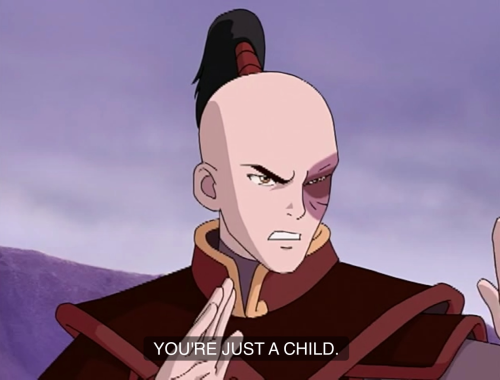
Sometimes I think about the fact that there is exactly one time that we hear someone express surprise at the fact that Aang–the Avatar– and his companions are children. And it’s in the second episode, from Zuko: 

image

From an out-of-universe perspective, this makes sense. And it wasn’t something that surprised me when I was a ten-year-old in 2005 when A:tLA first aired. One of the tenants, I think, of adventure children’s television is that there is a degree of wish fulfillment. Children want to be taken seriously as agents, and so it makes sense from that vantage point, that everyone takes the Gaang seriously as agents except the person portrayed as an antagonist.

But, I think this also makes sense, heart-breakingly and unlike other children’s adventure television, from an in-universe perspective. This is a world ravaged by bloody, bloody war for a hundred years. A world in which child soldiers are commonplace. We see countless examples of this throughout the series:

  • When we meet Sokka–fifteen-years-old and in-charge of security for his village–he is training small children to be soldiers. This is played off as something of a laugh, but if Aang hadn’t returned in the second episode, I think we’re supposed to think that Sokka very much would have tried to lead these little boys into battle.
  • Jet and the Freedom Fighters, who practice guerrilla warfare (fairly successfully) and regularly raid Fire Nation outposts, are children. Jet, who I think we are supposed to assume is one of the eldest of the group, is sixteen when he dies (according to the Avatar wiki).
  • The Kyoshi Warriors are one of the elite-most fighting force in Avatar World, eventually taken seriously by the Earth Kingdom military and given military jobs. And the general of the Kyoshi Warriors, Suki, and the eldest member of the group (again according to the Avatar wiki) is fifteen. She can’t have always been the eldest member. I’m willing to bet the older women are sent off to war, and Suki becomes the eldest member and the leader by default. (Much like Sokka–probably why they connect so well).
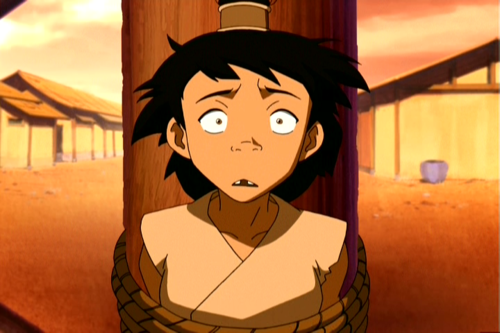
  • In Zuko, Alone, the soldiers in the village threaten to send Lee off to join the army at the front, and based on the mother’s reaction, and what we see of him when he’s tied up, this doesn’t seem like an empty threat, and it’s probably not the first time this has happened to children in the Earth Kingdom in villages like these.
image

I could go on. 

So of course, after living in a world of child soldiers like these, no one is going to bat an eyelash to learn that the Avatar–perhaps the ultimate non-Fire Nation soldier–is twelve-years old, and his companions aren’t much older. When Aang starts to bring this up himself to Yue, for instance, Yue doesn’t seem to understand. He’s the Avatar, he has to save them, she insists. Who cares if he’s a child?

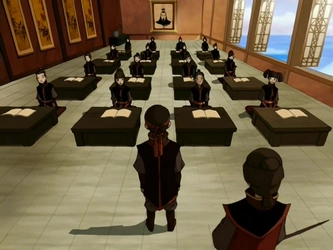
But the Fire Nation Army isn’t filled with child soldiers. It doesn’t need them. Fire Nation children are in school. It is adults that make up the Fire Nation Army. 

image

And, (with the exception of Azula and her gang), when we do see a Fire Nation child attempting to take on the role of an adult member of the military, he isn’t taken seriously. (E.g. Zuko, and the way Zhao brushes him off.)

So of course it is only Zuko, who grew up in the absolute center of the Fire Nation, and, though he is banished, hasn’t really seen much of the reality of the war until he meets Aang, that looks at the Avatar and remarks in surprise that he is a child.

(If anyone is interested, I wrote a fic that deals with a lot of these themes. It can be found here.)

This is not only an excellent analysis but I think it also ties in to one of the greater themes of the show as a whole, namely these kids are entitled to a childhood even in a broken world:

“Normally we would have told you of your identity when you turned sixteen, but there are troubling signs. Storm clouds are gathering.”

“I fear that war may be upon us, young Avatar.”

In their fear the Air Nomads were going to make Aang the first child soldier against the Fire Nation. In their rush to skip four years they lost a hundred. Aang rejects that role early on and constantly rejects it even as he accepts his responsibility as the Avatar.

He reminds Katara that she’s still a kid. When he connects to Zuko the first time it’s through the language of all the fun he used to have with his friends in the Fire Nation. Team Avatar takes the time they need for vacations and to make new friends. In doing this they start to heal the world person by person.

Aang most succeeds as Avatar when he finds balance between childish things and adult responsibilities. This rubs off on everyone. Sokka goes from desperate to be taken seriously to someone who sets himself up for a laugh, because he knows his own strength. Zuko spends season 1 as an imitation of Ozai, ends the show as someone who can lead a country and smile openly at a goofy drawing. 

They are all still very young with too many responsibilities on their shoulders. But they’ve also carved out an important space where they can be children with each other. All things in balance.

superhashslingingslasherz:

The Last Jedi end all be all Finn prediction

So, I don’t post ever but I needed to get this one out there.

Basis for prediction: In TFA i think I remember Snoke saying “there has been an awakening” right? Most would assume he’s talking about Rey as she ended up being the focal point for the force in the movie. But that really doesn’t make sense because she hadn’t shown any signs of any kind of awakening at that point. He was talking about Finn and his change at the village massacre. I think this is intentional and instrumental for this prediction.

Now in TLJ trailer once again we here Snoke speak of a force user. A “raw untamed power” as it gives us shots of Rey and Kylo and I feel as if that’s a misdirection and he’s really talking about Finn.

Reason 1: so we all know Finn goes “undercover” in the FO except, that doesn’t make any sense either because he should be on the FO’s most wanted list. I don’t think he’s undercover, I think they want him there specifically because of what he is and what he did.

Reason 2: the seriously suspicious lack of Finn merchandising and promo just doesn’t fit for a character so integral to the plot. Rian Johnson seems to imply there’s a lot more than meets the eye and I’m inclined to believe him. They focus on everything but Finn to not draw attention to him and his story. Hate it or love it they love their plot twists

Reason 3: we know he’s force sensitive (kinda). The problem is that it’s only implied atm. Now how to introduce said sensitivity without it feeling… forced(buh dum tsss) you make the audience realise that he was force sensitive the entire time. Rather than having yet another clutch dramatic reveal in the heat of battle. You foreshadow said sensitivity in TFA. Coming full circle to my Basis for prediction. Simple. Thanks for reading. Whaddya think?

Interesting! Here’s to hoping. I mean, I found the whole idea of Finn undercover to really stretch my suspension of disbelief, too. So maybe DJ makes him a fake ID in the system, whatever. Is DJ so good that he can rewrite human memory? When Finn is going into the wolves’ den with his face uncovered? As a Stormtrooper trainee he ate in mess hall with his face uncovered. He lived communally with other trainees. Any passing Stormtrooper could recognize him. And that’s to say nothing of Phasma and Hux, who quite recently reviewed his personnel files and presumably are not both face-blind, and Kylo Ren, who also saw Finn’s face at the very least during the fight on Starkiller Base.

Like… argh, are you fucking kidding me. How does that even work? Even if the movie turns out to be good, it would be the biggest joke ever if this undercover mission works the way it’s shown, with Finn waltzing into Snoke’s own flagship and going unrecognized for a decent amount of time. At the very least this is a terrible use of human resources, because by normal logic he should have debriefed and trained other undercover agents and let them take over. So there had better be something more going on, because otherwise the First Order are going to look about as menacing as a classroom in daycare.

Which is a long way of saying, I like your theory lol. And if the absence of Finn in the promo and merch is due to legitimate plot reasons I may even consider forgiving LucasFilm sometime in the next decade.

kyberfox:

lj-writes:

kyberfox:

I’m over the moon that Finn got that iconic line – “may the Force be with you” – but no one seems to be asking the obvious question, where did he learn it?

It’s not something the First Order would have taught him that’s for sure. 

Originally it was a Jedi greeting that the then Alliance adopted as several ranking members had had close ties with the Jedi before the rise of the Empire. The First Order want the Jedi wiped out and sees the Republic, the government formed by the Alliance after Endor, as an illegitimate power to also be destroyed. 

While I could see it spreading via the Church of the Force who’s teachings are based on those of the Jedi, it doesn’t seem to have spread into the general populace in the 30 years since the Battle of Endor, as far as we can judge by the canon material available.

It doesn’t even seemed to be used by the Resistance personnel in general.

So again, where did he pick it up?

My theory is that Rose said it to Finn, and Finn is repeating it back to her in a jocular, slightly disbelieving way. We have never seen this phrase used jokingly before, because when it was said it was always used in earnest at a pivotal moment in the films. The fact that Finn is saying it in a laughing manner not only fits his status as a rebellious, authority-critical hero, but shows he may be unfamiliar with it or at least its full context.

A major reason I think this is part of a scene with Rose is because of the background. Here’s a still of Finn saying the line…

And here’s an early shot of Finn and Rose talking.

They feature the same door, as far as I can tell, from different angles. (The difference in lighting is probably due to poor rendering of the TV spot, since the daytime scene with Rey also comes out dark in the video uploaded to YouTube.)

If Rose said this line and Finn repeated it to her in a cynical way, it would be in line with their relationship as described to us in various articles and interviews–that he wants no part in the fight at first (and I don’t blame him one bit) and she helps him believe in it and himself.

It would also be a setup for Finn saying the line in earnest later on as part of his character development, having found his own conviction and his own meaning in his journey. It will go down as a moment in Star Wars history much like Han coming back to assist Luke at the Death Star or Jyn’s rendition of this iconic line.

Funny you bring up that Finn seems to be disbelieving even ironic here. I read it the same way and it made me wonder if it was Rose or Poe he’s saying it to, as popular thought appears to be or if its an authority figure.

To me he reads like he wants to tell someone to piss off but can’t, in that his voice is very polite, almost formal, but his little smirk and tilt of the head kinda reads like “oh go eff yourself”. Because that’s not Finn’s smile when he means it, it looks utterly fake.

Of course, without context its hard to know. But yes it makes me think he’s saying it to someone in authority where he can’t say exactly what he means, so he resorts to this.

In Resistance context that would mean Leia or Amilyn Holdo, my money is on the latter.

If true, this just may mark the first time MTFBWU was used as a “fuck u” 😂

Alternate theory: Finn learned the phrase from archival materials he studied as part of his training, like Rebellion radio chatter intercepted by the Empire or something. It’s a fond headcanon of mine that he got the “war hero” bit from studying the old battles and coming to his own, wholly unapproved, conclusions.