attackfish:

Azula’s Earth Kingdom Doll

In the Avatar: the Last Airbender season two episode, “Zuko Alone”, Zuko flashes back to a time when he and Azula were both young children. In one of these flashbacks, he recalls Iroh, then a general in the Fire Nation army sending home an Earth Kingdom knife for him and an Earth Kingdom doll for his younger sister, Azula.

Azula scorns the doll, sticking her tongue out and setting it on fire. Much has been made of this reaction in fandom, mostly by Azula apologists who seek to make Azula look better by alledging Iroh didn’t care about her or was sexist and cruel to her because of it. I’m not paricularly interested in addressing this argument, here, as I have already addressed it in fic form, but suffice it to say it might ir might not show some latant sexism on Iroh’s part that he assumed Azula might like a doll, but it’s not exactly surprising that a man who hasn’t seen his neice for two years, possibly more, wouldn’t be well-versed in her interests, and it’s only very lucky that he hit on something Zuko liked. It’s entirely possible Azula at six loved the dolls she had no interest in at eight.

However, it’s another, much more bizarre assertion I have seen floated around by Azula apologists that I find fascinating, because of how it relates to a troubling historical truth: the idea that Iroh got Azula an Earth Kingdom doll because he wished to demean her by giving her a doll representing a people he viewed as lesser.

Historically speaking children of imperial powers often had dolls representing the peoples their forebears sought to subjugate. These dolls gave the children of an empire symbolic ownership over the people their dolls represented, enculturating them into the project of empire-building and into the entire notion of having power over the people their dolls rerpresented, just as they had power over their dolls. It wasn’t long ago that racist charicatures in doll form such as the gollywog doll [Link] were popular throughout the English-speaking world. Far from demeaning her, sending Azula an Earth Kingdom doll just as her family was on the cusp of conquering the Earth Kingdom very much fits into this pattern. The doll serves the same purpose as sending Zuko a piece of war spoils in the form of a knife.

What these gifts show us, more than anything about Zuko or Azula or their relationship to their uncle, is how Iroh viewed empire. He gave these gifts to his niece and nephew at the height of his imperial ambitions and belief in the rightness of those ambitions, and they show his comfort with empire and a desire to perpetuate it. This will soon change, and Iroh will become the man we know from the show’s timeframe, disgusted by empire, fighting for its demolishion and for the freedom of the people he once sought to conquer. But the gifts he chose to give his niece and nephew give a tantalizing glimpse into who Iroh used to be, and what he used to believe in.

Very good point! Also the idea that having a doll representing a “lesser” people diminishes Azula is… yaigh? To say nothing of the fact that Zuko received a knife from a defeated Earth Kindom general (which serves the same purpose as you point out), does that mean Iroh saw the young Zuko as lesser AND a loser, lmao

But oh wait… Azula really coveted Zuko’s knife… it’s almost like Azula stans are full of shit or something. 🤔

sithchirrut:

Going to cut out this part of @lj-writes comment to my meta because I might be going off on a tangent and I hate derailing, even my own posts.

Also, I went back and listened to John’s narration as Jake, and noticed something weird in the opening sentences. So my first impression was that the narration was supposed to go like this:

“We were born into a world at war between the monsters that destroyed our cities and the monsters we created to stop them. We thought we had sacrificed enough.”

Which would be straightforward, right? There was a war between the Kaiju and Jaegers, a war that caused untold loss.

But that reading is strange on a couple of levels. For one thing, the war wasn’t between Kaiju and Jaegers, it was between the Kaiju and humans. It would be like saying World War 2 was between Japan and nuclear bombs, it doesn’t fit. For another, that first sentence, “We were born into a world at war” sounds like a complete sentence and the next part, “between the monsters…” reads like the beginning of a new sentence.

So what if the narration actually reads like this?

“We were born into a world at war. Between the monsters that destroyed our cities and the monsters we created to stop them, we thought we had sacrificed enough.”

Completely changes the meaning, doesn’t it? It gets rid of the awkwardness of putting Jaegers, which are weapons of war, in the position of a party to the war. It also sounds closer to my ears to how John is reading the words.

Most significantly, this reading presents the Jaegers as an evil or at the very least a tremendous drain that demanded sacrifices–of expenses and resources, for a start, but what if there was more? Civil liberties? Human lives?

You’re absolutely right, it changes the everything completely. And there’s something else interesting in this light.

Because the speech goes on: “And the war we thought was finished, is just beginning” and while Jake says this, we cut back to the scene with child!Amara where civilians and helicopters of unknown affiliation are being attacked by the Jaegers and we see a Jaeger fire a group of missiles that seems to hit a military looking person.

There’s obviously more than one war going on here. There was a war between the Kaiju and the humans, but that’s not the only war we see here.

And then there’s Jake speech to the Jaeger pilots a little later:

“It doesn’t matter where you come from. Who believed in you and who didn’t. This is our time, our chance, to make a difference. Now let’s get it done.”

Okay, again. It could be your average inspirational speech before going to fight the Kaiju, that’s entirely possible, but with above in mind and the fact that the group we so briefly see looks a bit like a group of misfits, I’m again wondering if we’re seeing a bunch of idealists going rogue with their Jaegers. And taking them not just against the Kaiju, but against those who would use them against humanity.

It is also worth nothing in this context that it is after this point that we see all but one of the Jaeger vs Jaeger fights.

And then there’s the Kaiju themselves. In the first movie we were pretty much told that they were mindless monsters, end of story. But this time we’re told that they’re more intelligent than first assumed. And one of the scientists from the first movie communicated with them.

Makes me again wonder, who is going to be the real bad guy in the movie. If they’re going to reverse expectations, or if we’re going to maybe see two?

Yup, from the sheer amount of Jaeger vs. Jaeger fighting in the trailer it’s clear that conflict between humans is a major part of the film. It would be boring tbh if the fighting were all against kaiju, since there was sort of an entire movie about that already.

And regarding the part of the narration you mentioned, what if the “war we thought was finished” ISN’T the kaiju war, at least at first? As you point out, we hear this narration as we watch fighting between humans. What if the war Jake refers to is a conflict between states that the world thought was over with when the existential threat to humanity intervened, but flared up again after the kaiju war ended–this time with giant robots?

Also, what if the new kaiju threat is related to this human war? It always bothered me that the kaiju simply showing up again years later seemed like an invalidation of Stacker’s sacrifice. What if one of the parties involved in the wars decided to open a rift to bring the kaiju BACK to attack/destroy an enemy? (It was a major plot point in PacRim 1 that humans found a way to get into kaiju heads, after all.) Or it could be a Watchmen kind of deal where another idealist, this one twisted and ruthless, sincerely believes a new kaiju threat is the only way to stop war between humans. This way the two plot threads of interhuman and interspecies conflict would cohere together and not be a random pile of events.

sithchirrut:

sithchirrut:

Ever since we got the teaser trailer for Pacific Rim Uprising and I got some “semi creepy propaganda” vibes of it and its promotion of the Jaeger program, I’ve been wondering what the Jaeger program turned into post the First Kaiju war. And with the trailer released I’m wondering even more.

Because the Jaegers and the Jaeger program aren’t phrased as a good here – they’re literally called “the monsters we created” and it’s Jake who’s talking here – but as a necessary evil to fight a greater and more destructive evil.

I’m wondering if the Jaegers were used to keep a fearful populace in check? If Jake saw where it all was headed even before the end of the first war and that that is why he left the program? If he had a falling out with his father and sister about it? And if that’s why he got caught up in the criminal underworld which might be the only “free” place left?

Of course, with the Kaiju back in force the Jaegers are once more a very necessary evil and Jake decides for his own reasons to join up again to help.

A few more thoughts after watching the trailer again.

This would go a way to explain Amara, that 15 yo Jaeger hacker that’s in the movie. Why would someone hack a Jaeger?

Okay I know it’s common human nature for some to try and break into stuff where they shouldn’t be, not out of malice but just to see if they can. But on the other hand, it might indicate that some humans anyway seems to need/want protection from the Jaegers.

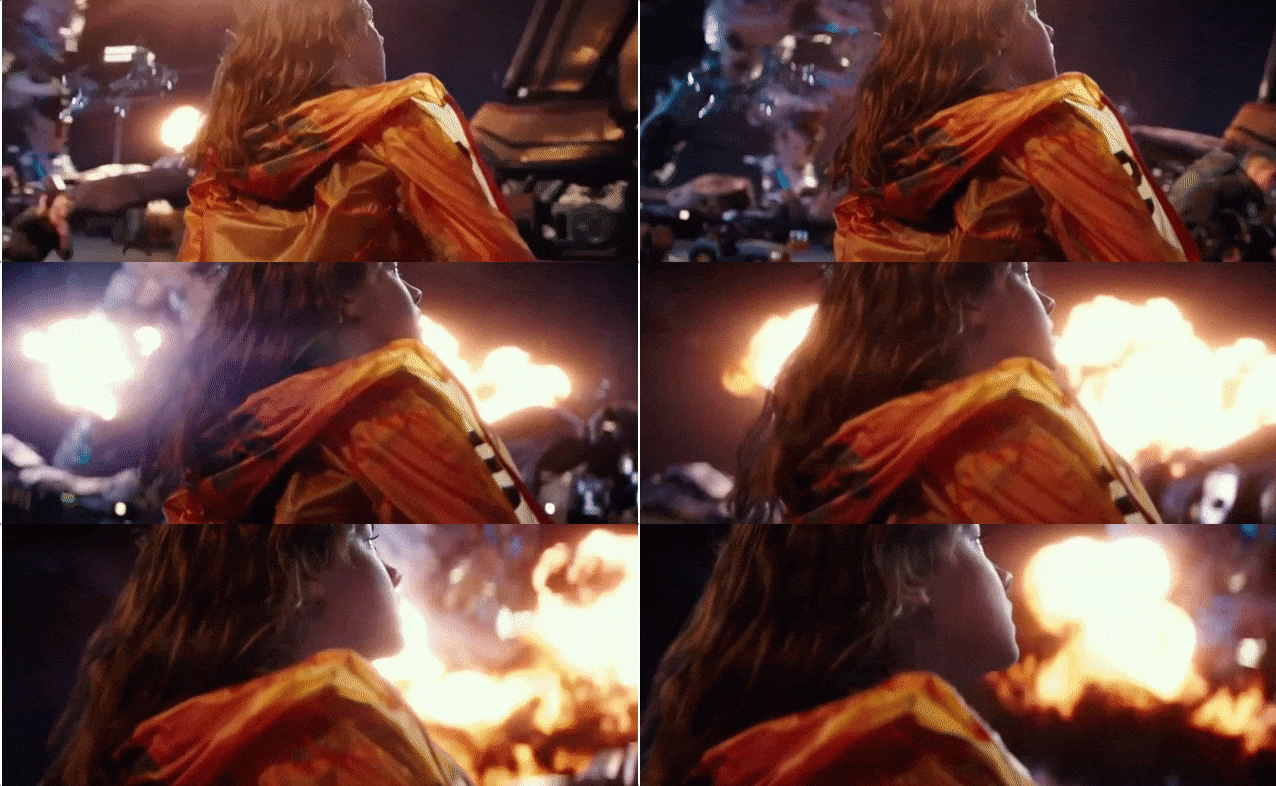
And then there’s the opening scene where we see said hacker standing in the middle of what looks like a Jaeger attack, but there seems to be no Kaiju around. It looks more like the Jaegers attacking ordinary humans. Then a bit later we see Jake get off something (a helicopter carrier?) along with the 15 yo girl. So she’s with him, and by extension probably part of that criminal underworld mentioned in the synopsis.

Holy shit, I think you’re on to something! You’re right that we don’t see kaiju in the opening of the trailer. In fact, look at what a Jaeger is doing in the background here:

It’s smashing an aircraft, not fighting Kaiju. This is either Jaegers being used in warfare or in some kind of civilian repression, and I’m guessing the latter because this is clearly an urban area and not a battlefield.

Also, I went back and listened to John’s narration as Jake, and noticed something weird in the opening sentences. So my first impression was that the narration was supposed to go like this:

“We were born into a world at war between the monsters that destroyed our cities and the monsters we created to stop them. We thought we had sacrificed enough.”

Which would be straightforward, right? There was a war between the Kaiju and Jaegers, a war that caused untold loss.

But that reading is strange on a couple of levels. For one thing, the war wasn’t between Kaiju and Jaegers, it was between the Kaiju and humans. It would be like saying World War 2 was between Japan and nuclear bombs, it doesn’t fit. For another, that first sentence, “We were born into a world at war” sounds like a complete sentence and the next part, “between the monsters…” reads like the beginning of a new sentence.

So what if the narration actually reads like this?

“We were born into a world at war. Between the monsters that destroyed our cities and the monsters we created to stop them, we thought we had sacrificed enough.”

Completely changes the meaning, doesn’t it? It gets rid of the awkwardness of putting Jaegers, which are weapons of war, in the position of a party to the war. It also sounds closer to my ears to how John is reading the words.

Most significantly, this reading presents the Jaegers as an evil or at the very least a tremendous drain that demanded sacrifices–of expenses and resources, for a start, but what if there was more? Civil liberties? Human lives?

There’s more evidence that Jaegers are being used in conflicts between human groups. There’s the scene of missiles flying in from behind Jaegers to hit some kind of command center, and since when do Kaiju shoot missiles? Those are clearly of human make.

And of course, since those in power make the rules, the “criminal underworld” may simply be people trying to live away from the police state’s control and outlawed for that reason. This possibility helps me feel a lot better about the whole criminal angle, because I really was not looking forward to the prospect of Jake being some unruly delinquent that Mako has to talk into doing the right thing.

If the Jaeger program did go bad, it’s likely to be after 2025 when the events of Pacific Rim took place, since the program was being shut down in the early to mid 2020s and wasn’t in a position of power. Since Stacker died in 2025 before the Jaeger program was diverted Jake’s fallout is unlikely to have been with him, at least over this particular issue.

The period after 2025 and Stacker Pentecost’s death would be a perfect time for the rot to set in. There would be the enormous political capital from the awe toward Jaegers and pilots, the surplus military hardware available at a time of peace (from the Kaiju, anyway), and the militaristic mindset of preparing for the next war through “unity” which would really be thinly-veiled code for obedience and suppression of dissent. All this would set the stage for the countries in the Pan Pacific Defense Corps to turn against each other and/or their own populations.

Assuming Jake had moral objections to the direction the Jaeger program was taking he’d have all the more reason to get off the grid into the underground. Much like Mako, he’s a child of Stacker Pentecost and a perfect pawn for propaganda. If he wants no part in that he’d have to go into hiding because repressive police states are not known for taking kindly to rejection.

sharpayisalesbian:

Tbh “Finn is the Luke Skywalker of the new trilogy” makes so much sense tbh because he’s the perfect candidate to be a Jedi. His experience in the First Order was one with few human connections, and H*x and Ph*sma did their damnedest to beat all of his emotions out of him. He’s seen Kylo Ren’s temper tantrums. And he came out of the fight against the First Order angry, physically scarred, scared shitless, and kind of lost. In the Resistance, he’s surrounded by people who adore him and can relate to the pain of loss and the horrors of war, but no one who could understand the depth of what he’d been through. I

t would be so easy for the Jedi to convince him that the only way to deal with all of this pain, anger and grief is to keep a lid on it, isolate himself, and avoid deep emotional bonds. “Passion, yet serenity” would sound so soothing to him, and the Jedi would greatly benefit from a Jedi Knight with his levels of compassion and caring for other people. But his strength lies in the love he gives out so brightly and passionately. I want to see Finn going to the Jedi seeking solace and realizing that his love and kindness are his strengths and comfort, not a tool to be used by which side of the Force he chooses.  I want Finn to realize that he is a hero not because of any title he may have, but because the goodness in his heart perseveres even in the most hellish of situations. 

porgsitter:

diversehighfantasy:

her-father-he-is:

Question, if the so called ‘bridal carry’ (which is of course really a monster carry) is so important and meant to be taken as significant foreshadowing of a romantic relationship between Rey and Kylo then why doesn’t the TFA focus on on it more?

Aside from the initial knocking Rey out and catching her we only ever see the monster carry from Han and Finn’s POVs. 

[long post, lots of screen shots]

Keep reading

100%.

We’re meant to feel Finn’s horror and fear as Rey is taken. No question. If it was romantic at all, it was Finn screaming for Rey that indicated love, not the monstercarry.

Absolutely! We – ie. the viewers – are meant to feel the horror of this scene through Han’s and especially Finn’s eyes! There is never a closeup of the monstercarry… never any indication that the viewer should pay attention to how Kylo carries Rey, but all about HOW the others react to Kylo abducting her. We are meant to feel especially with Finn in this scene! Because this is his first real friend being abducted by the organisation that he had just escaped from…and looking at how he has just tried everything to get away from them, the fact that he, without any preparation or backup, is ready to run straight into the ship to save her… that truly says something! and Han sees his son for the first time in years, abducting the young woman he has just taken under his wings… so this is obviously meant to be a horrifying experience! And meant to make the audience go “NO!”

What creeps me out about the way some fans make the monstercarry so central is their refusal to empathize with the characters the scene and, like, common decency? set us up to empathize with. How can you watch the leaden pain in Han’s face, hear Finn’s heartrending scream and then turn around to sigh about how romantic it was that a torturer and mass murderer assaulted and abducted a young woman?

The op makes this point very well, that the whole sequence was constructed to emphasize Han’s pain and especially Finn’s horror and bereavement–and yet somehow the sweeping cinematics and the performances of 2 superb actors who were so close up they were practically in the audience’s laps were not enough to move some fans and that’s scary.

sithchirrut:

@skispeederfinn’s post about this scene

Int. Starkiller Base – Junction Area – Day

Finn, Han and Chewie take cover, Chewie pulling some explosives out of a duffel. Blast doors nearby.

FINN: We’ll use the charges to blow that blast door. I’ll go in and draw fire, but I’m gonna need cover.

HAN: You sure you’re up for this?

FINN: Hell no – I’ll go in find and try to find Rey – (improvising, fast) – The troopers’ll be on our tail. We have to be ready for that. There’s an access tunnel that’ll leads –

made me think about how unique it is that Finn allows himself to be emotionally vulnerable with Han and how it shows how deeply he trusts Han on an emotional level. 

Because it sure as hell isn’t something he’s used to doing with an adult, as most if not all adults in Finn’s life so far would have been authority figures who would have condemned him at the very least for such a “weakness” as the one he so readily shows to Han.

Contrast this on how he acts with Phasma, an important adult figure in Finn’s life.

After his return to the Finalizer after the massacre of Tuanul Finn is having a breakdown. He seeks out a private place to have it, knowing that it wouldn’t be an acceptable reaction to have.

As he walks into the darkened corridor he even looks over his shoulder to make sure he’s unobserved and unfollowed before removing his helmet and allowing himself to panic over what just happened.

Enter Phasma.

Finn’s behavior changes the moment she’s there. Despite still very much being traumatized and in a state of panic, he immediately straightens and tries to get a hold of himself. Phasma is not emotionally safe for him, he knows this.

But Han on the other hand has earned Finn’s emotional trust over the course of the story by actions such as:

  • Thanking Finn for bandaging Chewie. Finn’s reaction here makes it clear that he never expected thanks for it and he’s both pleased and uncertain when Han does.
  • Not only not condemning Finn when he decides to leave on Takodana, but telling him to keep the blaster rifle he just lent him. This might be a bigger deal to Finn than it appears to be on the surface, remember how afraid Finn still is and how he frantically searched for a weapon on Jakku? By giving him the means to defend himself Han might have been giving Finn a bigger gift – from an emotional perspective – than a blaster rifle might normally seem to be.
  • Asking Finn if he’s okay after saving his life during the First Order’s attack. Finn is not used to others looking out for him or checking how he’s doing outside of a purely functional perspective. But Han’s concern here has nothing to do with Finn’s ability to perform, it’s purely emotional.

So when Han asks him if “he’s up for this” (i.e. the attack) Finn does something that for him must be very usual, even unique. He lets his highly competent soldier side step aside for a moment and lets Han see the frightened, vulnerable young man that he also is. 

It’s only for a moment and then the soldier side of him is back to planning their assault, but that Finn – willingly and knowingly – lets Han see that side of him at all, does nothing to hide it… that says a lot of how much he’s come to trust Han emotionally in the short he’s know him.

It also makes me wonder how losing Han in the way he did, seeing him murdered by his own son, will affect Fin’’s journey going forward.

I HAD NOT EVEN THOUGHT ABOUT THIS OMG and I’m really kicking myself here for fixating on Han and Rey’s bond to the exclusion of the much more understated but also crucial relationship between Han and Finn. Smh at my own sexist and racist biases here.

I agree with all the instances you mentioned, plus there’s also another crucial interaction: when Han saw through Finn’s lie about being a big deal in the Resistance and told him as much but chose to let it slide, even handing Finn a blaster nevertheless.

This is huge for someone who grew up abused. Not only do many victims turn to deception protect themselves, being discovered in a lie is often the ultimate nightmare because you’re now going to be mistreated for the truth you were trying to hide and be punished for lying.

Instead Finn is given a message he probably never had been before: I know you’re lying but I’m not going to pry because I respect your boundaries. I’m sure you have your reasons and you’re smart enough to handle your own business. But you know, just fyi, she’s going to find out. Also have a deadly weapon while we’re at it because why not?

I respect you. I believe in your capabilities. I know you’re a good person. I trust you with my life.

Those four sentences are, at minimum, the basis of a damned good friendship and a solid familial relationship as well. I’m pretty sure most of us can name at least one family member we couldn’t convincingly say all four to.

This also ties together in interesting ways with Finn’s distrust of authority, since Han never approached Finn as any kind of authority except in the sense of being older and more knowledgeable. He treated Finn as an equal, one he trusted and respected, and I think it was just what Finn needed at that point in his life. Han should have taken Finn a little more seriously than he did, though, because Finn was right about there being First Order spies at Maz’s and taking BB-8 out in public was a huge mistake.

I wonder if, in addition to suffering from the loss of Han and feeling a lot of rage at Kylo Ren, Finn will end up adopting some of Han’s style toward those who look up to him? Finn is probably not going to be a conventional authority figure given his experiences and the ways he reacted to them. I think treating those who look up to him as friends and equals, trusting their judgment and letting them make their own mistakes like Han did, would be more suited to who Finn is. I look forward to seeing if his relationship with Rose bears this theory out.

It never sits right with me that Cassian is called a former Separatist. Cassian, as @attackfish pointed out, was born 26 BBY and was at most seven years old when the Clone Wars were over and the Separatists were officially defeated in 19 BBY.

I mean, child Cassian may have thrown rocks and bottles at the Republic military, maybe even tagged along with Separatists to give what help he could, but that alone does not make him an insurgent. It is factually, morally, militarily, legally, and humanly wrong to call a child a combatant when he was being a kid in a community under attack. That’s the kind of rhetoric that gets children murdered.

Flip the script, though. What if this was a story that Cassian spread about himself? What if he himself claimed to have been a Separatist and the story spread? What would he gain from telling such a lie or, at the very least, gross exaggeration?

Well, there’s an element of fear and respect, of course. Maybe his enemies would think twice before tangling with a battle-hardened insurgent. Maybe he wanted his comrades to take him seriously. Maybe he wanted to get into the Rebellion and forged his credentials. (”Oh hey, I used to kill Republic soldiers. Can I get in on this Alliance to Restore the Republic action?”)

You know what I think, though? I think he originally made up that story to lie about his age.

Imagine Cassian at fourteen or fifteen, with nothing more to lose and nothing left for him at home except ruins and grief. He wants to join the Rebels but they’re like, hey um, there’s a little problem. You’re underage, come back when you’re old enough to drink kthxbye

And Cassian, rubbing at a moustache that is totally not makeup and speaking in a falsetto baritone that is totally his natural speaking voice, tells them: HOW DARE U I’M NOT A KID I’M TWENTY-FIVE. I USED TO BE A DANGEROUS SEPARATIST AND I’VE KILLED CLONE TROOPERS FOR LESSER INSULTS IS THIS BECAUSE OF MY HEIGHT I’M SUING FOR EMPLOYMENT DISCRIMINATION

And the Rebel recruitment officer is like… okay…? It’s not like they can pull records to check anyway, even if the records from Separatist planets were all intact.

So young Cassian joins the Alliance, head held high, and the story spreads and becomes part of his mystique. Sure it might not match with some of his other biographical details and his close friends might know it’s bullshit, but the story was useful on multiple levels and he didn’t bother denying it when people asked.

sithchirrut:

reylos remain the creatively and narratively most boring, uncreative group of people I have had the misfortune to know of. they have so little clue about how to make a character conflict in anyone who isn’t a straight, white man, I constantly suffer massive second hand embarrassment just from having to see those so called metas

Saaaame. As a fellow writer of obsessive long-ass fannish essays I feel positively insulted by what canon Reylos churn out. No that is not how you logic- that screenshot doesn’t support what you just- HAVE YOU SEEN THIS MOVIE?

That’s not even going into their issues with racism and antisemitism. It haunts me that the massively antisemitic reylo meta on Reddit that completely ignores Finn’ s existence and assumes Kylo Ren is the hero went pretty much unchallenged.

luminousfinn:

image
image
image

This sequence between Finn and Han damn near kills me.

You can see how nervous Finn is in the first gif. His face is a mix of worry and low key fear. His body language is stiff and he’s pulling his shoulders up the way people do when they expect aggression or criticism and are trying to protect themselves from it.

And he looks so surprised in the second when Han starts talking. he is not expecting to hear what he hears.

Now Han have been nothing but gruff and terse with both Finn and Rey – and only a minute before Han was yelling at Finn – so obviously Finn expects nothing polite or kind from him even just going by that.

And what Finn just did was take care of the team, looking after an injured and weak team member, something that have never earned him anything but scoldings and critique. For the first time in his life, Finn receives praise for what comes natural to him.

So it’s no surprise that when Han is done talking Finn’s initial reaction complete and utter surprise. He can’t believe what he just heard.

image

You can see him straighten up and become more confident when he realizes that yes he did hear what he thought he heard. And that little smile Finn has on his lips before he gets distracted by the accidentally turned on holochess board is nothing less than heart rendering.

image

Spot on! The thing about a lot of Finn moments is that the character comes through very subtly yet unmistakably through John’s acting. The intersection of emotions and comedic moments deepen the character’s humanity, too, although some look at just the comedy (accidentally turning on the console in this case) and miss the underlying pathos there.

finnisthebalance:

Okay, Finn is a hero for what he did to help lead to the destruction of Starkiller base, but I want to make a very important point.

Poe nailed the critical hit.

Finn and Han and Chewie got the shields down, blew a hole in the walls of the oscillator, created the valuable opening for the resistance.

And Poe flew in there alone and shot up the whole place to actually blow it up. Knowing full well he probably could have died and intentionally flying through explosions to keep shooting up the oscillator.

Starkiller exploded because of Finn and Poe.

What’s more, Poe went in alone because he was losing people there and he HATED it. He explicitly chose to take the greatest risk alone because he couldn’t bear to lose anyone else and he was sure of his skills.

This go-it-alone heroism is a pattern with him, and it is a flaw as well as a strength. When the going gets really tough he chooses to shoulder the risk alone, and while it’s worked out because he is that good (and that lucky–Finn was his fortune😍) there’s no saying this streak will continue. It’s a great quality in a pilot but dangerous in a leader. Maybe that’s a source of the tension between him and Leia, because Leia wants him to succeed and also worries about her boy. Their respective traumas may clash in really interesting ways.