I’m guessing you mean ALL or ANY of the female characters could be replaced by a sexy lamp without the plot falling apart. That said, much as I dislike TLJ, I disagree. The female characters in TLJ were by and large not inert plot devices, I can say that much, though enragingly enough it’s Leia who comes closest to that description due to spending much of the movie in a coma.
My issue with the way these characters were written is that they were not given their own stories but rather made to serve the stories of male characters with a fake sheen of empowerment. Rose was there to “set Finn straight” or whatever (there are so many levels of racism and sexism in this thinking it’s dizzying), Rey to try and bring Kylo back to the light and ultimately show how far he has fallen, and Holdo and Leia to guide Poe to be a leader. The flaws and traumas of these women are made subservient to the needs of male growth and change, and in the case of Rose and Holdo especially, instead of having their own messy humanity they are Right for the Edification of Stupid Men.
I’ve heard it said that feminism is the radical notion that women are human beings. If women are not allowed their own flaws and biases but can only be omniscient and hyper-capable devices to help and teach men, then they’re not being treated as human beings. Among its many other flaws TLJ is a fake feminist story, and predictably White Feminists™ in particular are eating it up.
All of my white feminist friends loved TLJ. I absolutely cannot comprehend how, but they all see Leia, Rey and Holdo, in particular, as strong women without seeing any of their massive flaws. To the point that they rage at me for daring to criticize them, saying I’m just afraid of women in power. I don’t understand how they can’t see that I’m actually further on their side than they are.
I suppose I can’t blame them, though. Women get so little good, strong actual women in power, and so little good representation that when they see anything, even–even really shittily written and executed characters–they eat it up. It still amazes me though, because they’re just so offensively badly written.
I suppose you could bring up the absolute butch job done on Phasma. Phasma who has always been marketed as this incredible big bad and has been sidelined this entire series, getting taken out by a cheap shot.
@brotherskywalker Yeah, I mean conventionally strong female characters can be great wish fulfillment so I can see where your friends are coming from, but I tend to side-eye the interpretation that it’s some kind of feminist triumph for female characters not to have their own stories but rather primarily teach male characters lessons.
And they can be read as less shining beacons of righness and more as characters with biases and weaknesses as you point out. I think that’s way more interesting, actually. Rose’s story can be about her grief and confusion in a situation where she lost her only remaining family and is losing the one thing she has left, the Resistance. Holdo’s story can be about her hubris and blind spots as a commander and as a survivor of genocide. The focus is all wrong for these readings to really gel, though, and rather than lend itself to multiple interpretations the execution of the story lurches between confusing and offensive.
@grandoljoe Phasma of all characters could actually have been replaced by a sexy lamp, smh. RJ even took out the scene where she shot the Stormtroopers to cover her ass. I’m really disappointed with her character in both TFA and TLJ, all the more because she had so much potential.
When you get a fave/kudos notification
What’s the story you immediately think of, like “oh, it’s for THAT fic”–and you’re usually right?
Okay going to have to start looking for places and programs where I can actually try ancient Korean spinning and weaving because no way in hell can I get it right without getting my hands dirty. The first draft might be workable with whatever information I can glean on paper and online, but I can’t half-ass it for the final product.
Tagged by @jewishcomeradebot! The rules are as follows: Go to page 7 of your WIP, go to the
seventh line, share seven sentences, and tag 7 more writer-bloggers to
continue the challenge.
I shared from my original work before, this one’s from fanfic in progress. Well actually it’s from a completed first draft I’ve been needing to edit and post for weeks. Maybe this will finally give me the necessary kick in the seat.
“Launch sequence complete.” The Talon Fighter lifted into the air and sped into the sky amid shouts of confusion. Shuri smiled to see it go, biting the inside of her lower lip.
Back at the laboratory Ramonda sat in the bubble that was the simulated cockpit, moving her left hand across a translucent globe before her. The view outside the windshield splashed across the curved barrier before her, and minimal movements in the fingers of her right hand brought up overlays of views from different angles and reports from distant viewing stations, homing in on the ships speeding toward the border.
“I have a visual on the transports, Shuri.” A subtle squeeze of Ramonda’s left hand, and the royal ship took on a burst of speed toward its first target.
This is an ultimate masterlist of many resources that could be helpful for writers. I apologize in advance for any not working links. Check out the ultimate writing resource masterlist here (x) and my “novel” tag here (x).
But don’t worry, most writers are and I’m here to help because reading them is making me cRAzY.
I’m writing this because I’ve read three otherwise great romance novels back to back featuring characters dealing with PTSD (or PTSD symptoms) and each one of them made the same dream mistakes. I honestly can’t think of a fiction book I’ve read that didn’t make these mistakes, so I thought I’d compile a handy dandy list of mistakes and how to fix them.
Lucky for you, I have PTSD and a ton of fellow veteran friends who deal with these symptoms.
*This is based on my experience and things told to me by friends. This is not to say that the below doesn’t happen in real life, only that it’s not as common as you might think.
The issue with these dreams is twofold: on one side is the psychological accuracy of the dream and on the other side is how you’re using the dream within the narrative.
Oh an Black Sails spoilers-ish ahead.
1) Stop writing the dream as a shot-by-shot accurate retelling of Traumatic Event.
Listen, not only do dreams seldom follow reality, but our own memories are tricky at best. I don’t remember getting beaten up because a) it was horrifying and we block stuff like that out and b) I was going in and out of consciousness. It would be pretty strange for me to dream something I don’t even fully remember. Our brains are simply not wired to do these vivid factually-accurate cinematic retellings.
My friend dreams things that did happen, but in his own words those dreams are always wrong in some noticeable or bizarre way. For instance, he’s getting chased through the streets of Iraq by a werewolf.
2) Dreams are informed by reality, not direct reflections of it.
It’s entirely likely my friend dreamt of a werewolf in Iraq because I got him binge watching Supernatural and the two ideas merged in his dreamstate. But see, that’s how dreams work.
The trauma event exists as a constant in his subconscious, but he has all this other information right there in his conscious mind all day, every day. In dreams, there isn’t a clear delineation between that information.
My dreams are often dependent on whatever I’ve fallen asleep watching on television. The themes are consistent, but not the content.
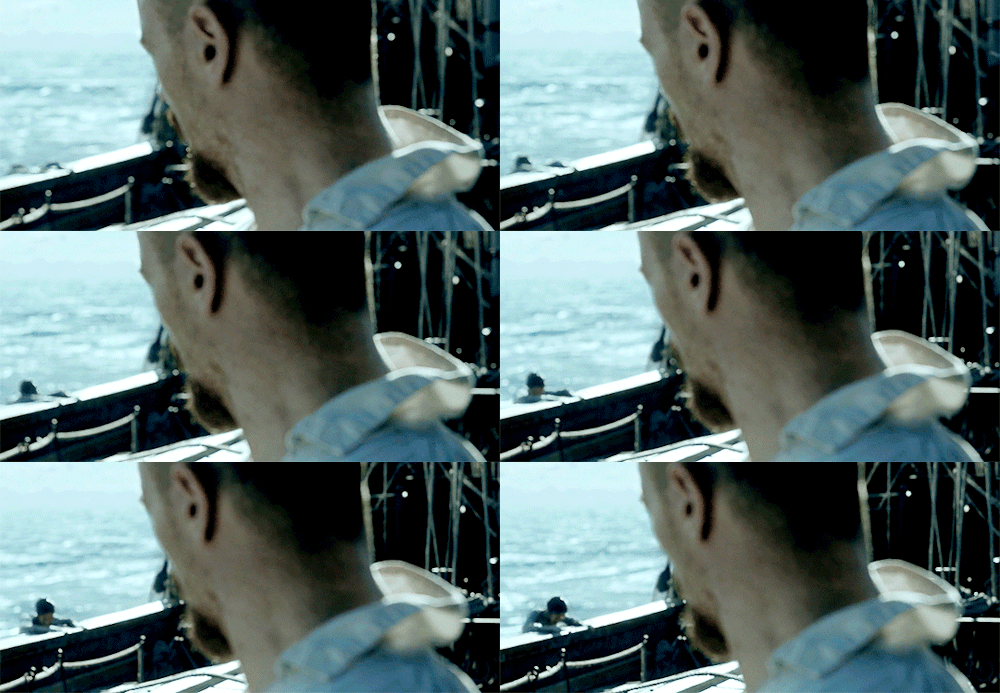
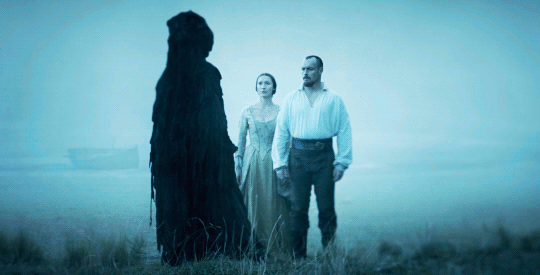
In Black Sails, Captain Flint’s trauma dreams feature his dead partner and friend following him around his empty ship. You have an element of the trauma (the animated corpse of his friend) + his daily existence (his ship). The two things intersect to form these unsettling nightmares as expressions of his fears and grief. He never once relives the event itself in his dreams as shown on screen.
Speaking of…
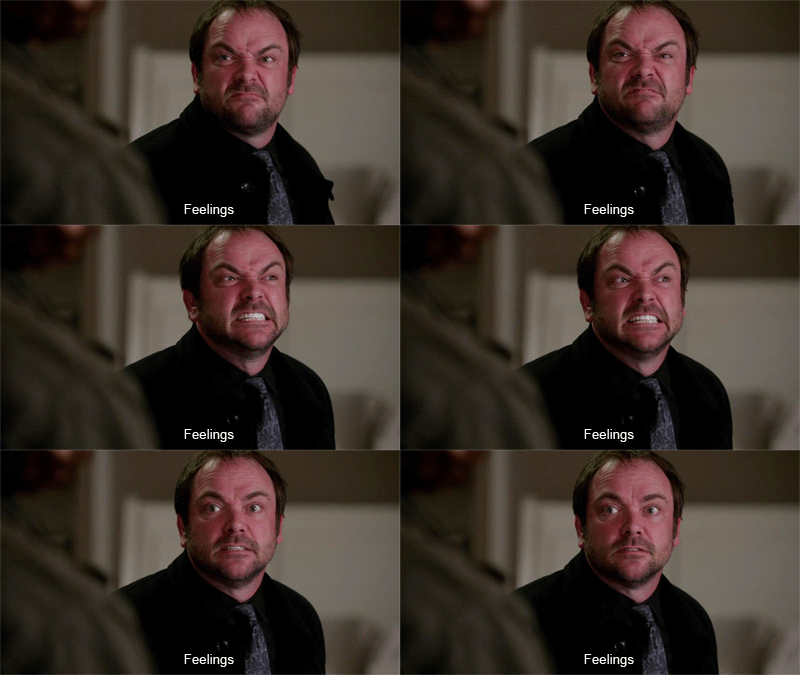
3) Trauma dreams often revolve around feelings, not necessarily the events themselves.
The PTSD package generally includes heaps of shame, guilt, anger and fear. As someone who survived a beating when I should have had control of the situation, my dreams tend to revolve around fear that people will know I’m a fraud or being unable to act in a dangerous situation.
Again, it’s entirely common for trauma victims to not remember large chunks (or the whole thing) of the trauma event. So why should their dreams be stunningly accurate? What we remember are feelings. Real strong feelings.
You cannot go wrong if you write your trauma dream around feelings, not a specific event.
4) If you present trauma dreams as expressions of themes, you can let go of the trauma dream as an exposition dump/way overused suspense trope.
You know you’ve read this: MC has dreams that are a shot-by-shot retelling of Traumatic Event that always cut off right before Traumatic Event, so that the Big Reveal must happen by a discovery later in the novel.
If I were the MC in a book, the easy and common thing would be to use the “dream sequence” as an expository retelling of Traumatic Event as a way to give some backstory to why I might be surly, mistrustful, afraid to try something new, whatever, and to clumsily shoehorn in suspense where there doesn’t need to be.
The much more interesting thing might be if my dreams were inconsistent in content but consistent in theme. In one I’m on an alien planet (because I fell asleep watching the Science Channel again) and the ground opens up and I fall into a pit from which I can’t escape because I am helpless. In another a man is watching me while I sleep where I am again frozen and helpless. This would force the reader to think: what is the recurring issue in these dreams? Why is it important? What is this telling me about this character and what happened to her?
It could be a personal preference, but I’d rather see the Traumatic Event either told in narrative flashbacks (not dreams) or verbally retold by the character in question. Let the dreams tell me something deeper about the character. It’s not that I was beat up, it’s that I feel like a failure because of it. One of these things is a shallow factual detail, the other tells you something about me as a person that I’m sharing with you, gentle reader, because talking about this stuff is healthy.
5) The Traumatic Event doesn’t have to be a big secret.
In Black Sails, we know what happened to Captain Flint’s partner. It happened in real time in the show. That didn’t make his uber disturbing dreams less disturbing or mysterious. Fans still debate exactly what the symbolism was and what they were telling us about James Flint in those moments. We do know from the dreams that he was disturbed, obsessed, and also monumentally guilty and blaming himself for what happened.
The mystery was perhaps more heightened by the fact that the dreams weren’t direct reflections of reality. We know who this person was, what she believed, and why she died. That Flint is imagining her screaming silently in his ear is horrifying and discordant with what we know to be factual. This adds emotional complexity to his character and the decisions he’s making while suffering these dreams.
^^^this didn’t happen. It was a dream. A real unsettling dream.
Once you let go of the concept of the trauma dream as a literal retelling and exposition dump, you have the entire dreamscape to work in other narrative elements, like symbolism, metaphor, foreshadowing, etc.




 L.J.'s Obsessions
