
It’s an interesting idea and I think that’s how Johnson was trying to go (minus giving Phasma or Hux any meaty role), but I think that also has the risk of splitting the plot in three. Ultimately I think it’s more satisfying to have a central Big Bad so that the plot coheres into one, especially in movies for theatrical release.
Tag: xilizhra
Fair enough. I apologize for the derailment. I think one reason I wanted to defend Rose is that I think she was very ill-used by the film in general, and in a way, I blame her less for the tasing than I do Johnson directly. But I shouldn’t have derailed.
It’s true Rose was treated terribly and somehow the expanded materials by other creators do far more justice to her than Johnson did his own character. I’ve written several posts about the discrepancy between Cobalt Squadron, the junior novel starring Rose, and TLJ/its novelization.
It’s not even the fact that she committed a shitty act of violence against an unthreatening ally that bothers me, either. People can do awful things and then make amends, and those are some of my favorite kinds of stories (e.g. Zuko from ATLA). What bothers me is rather the refusal to admit, both on the part of the narrative and the fandom, that what she did was shitty and wrong. Not only does it result in the terrible and racist implication that Finn deserved violence when he wasn’t threatening Rose in any way, but it also takes away from Rose’s own story of learning to cope with grief without hurting others.
Because I came to mostly agree with you about Rose, so fewer words were necessary there, while I wanted to make a different point on the same event.
Yeah, a “different point” like have I maybe considered that immoral thieves deserve to be tased, thrown across a room, and temporarily paralyzed? Isn’t it interesting how this logic gets applied to every real-life case of a Black person being killed by police? They were a robber, they did drugs, they didn’t follow orders… until suddenly the conversation is no longer about the violence done against them but an indictment of them as a person.
Like, maybe examine your own assumptions here and why you felt the need to bring up whether Finn was being immoral and a thief in a conversation about whether violence against him was justified. That’s not a different point on the same event, that’s a derail.
All right, “defend” was too strong a word. I’ll downgrade to “understand.” Though I would also say that Finn’s plan was downright immoral, as it’d deprive Resistance members of an escape pod while he wasn’t even in immediate danger. But yes, Rose was also trigger-happy there.
I mean I guess people can do a lot of violent and unjustifiable things in the heat of rage and grief. What bothers me about TLJ is that there is no acknowledgment that what Rose did was, at the very least, over the top and uncalled for.
The second part of your ask is an off-topic diversion. The conversation was about whether Rose was justified in using violence against Finn when he was not threatening her in any way and there was no indication he could not be talked out of his plan. I happen to disagree with you that his plan was immoral, but let me ask you a more fundamental question: Why does it matter? Do people who make an immoral plan deserve to be physically hurt and humiliated, especially when they can be stopped without such violence? Why did you change the topic to Finn’s immorality when the topic is about the immorality of the violence used against him?
I think you really need to examine why you’re so eager to justify and victim-blame here, and are unable to admit Rose was wrong without bringing up the irrelevant issue of Finn’s wisdom and morality.
While it was a bad filmmaking choice, to say the least, I will defend Rose tasing Finn in-universe. Using an escape pod–a craft that can, IIRC, fit six people–by yourself to leave a ship before it’s in danger of being destroyed strikes me as an untoward thing to.
I’m still trying to process how you went from “Finn was going to do an unwise thing” to “Rose was right to tase a completely unthreatening and unarmed Finn, throwing him into a wall and knocking him unconscious.” Even if you think he should have been prevented from taking a pod, what about the situation prompted you to think Rose used a proportional or justified amount of violence? Why do you think Finn couldn’t be, you know, talked to?
One other thing; which interpretation of Kylo are you leaning more towards? Terrifying portrait of fanaticism, or laughable manbaby who can’t possibly keep the First Order together?
Like there’s a lot of daylight between the two? Fanatics are fundamentally ridiculous, but that doesn’t mean they’re any less dangerous. It seems you’re actually exemplifying the othering concept of evil we’ve been discussing, as though a truly terrifying evil must be aloof and inhumanly effective rather than laughable and buffoonish.
The Jewishcomradebot article link is broken, so finding the original piece was tricky. But I disagree about Vader’s villainy being more over-the-top than Kylo’s. In terms of personal evil done, Vader is actually pretty downplayed in the OT; he tortures and summarily executes people, but never personally massacres innocents like Kylo has. He did do that in the PT, which interestingly is him when he’s outwardly more human and relatable and not in a suit of dark armor. I would also say that Snoke–
is a much more over-the-top figure than Palpatine in TFA, being a
giant, ghostly, alien Lincoln Memorial; he was then humanized in TLJ by
becoming a shortsighted loser in a Hefner bathrobe. And, of course, Hux
is much shoutier and hammier than Tarkin. The ultimate upshot of which
is that I’m skeptical of TFA being a better showcase of the banality of
evil than previous movies.
In case others are having difficulty, here’s the current link to the full post (link). Idk if you were able to read the whole post or not, but the point in the op wasn’t that Vader was more evil than Kylo Ren, it was that Vader was presented as more otherworldly, distant, larger-than-life as opposed to the more humanly presented Kylo Ren. Anakin began his career as a Sith while still unmasked, yes, but iirc his eyes were already starting to go Sith-gold and the culmination of his transformation was that he became a masked villain with a machine voice like the Vader we know and loathe.
The op only mentioned Snoke in passing in relation to Kylo’s bloodline, and you seem to have missed the point about Hux entirely: Hux, the overt Hitler caricature, was a secondary one-note villain and it was Kylo, the human, “relatable” villain, who was the main face of evil in TFA. The argument as I understand it was not that TFA was in all ways a better representation of the banality of evil, but that Kylo Ren is a better example of it than Vader and the villains who better suit the idea of an alien and demonic evil take the back seat to Ren.
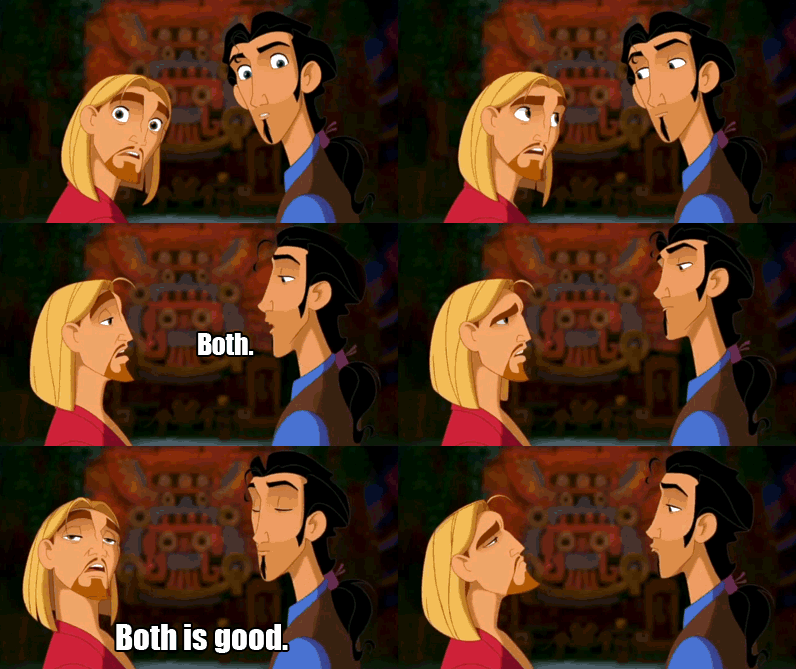
Oh, Prince of Egypt. While this is more the source material’s fault than anything, I remember feeling highly fucked up about the movie presenting the mass murder of children (by God) as anything other than horrendously evil.
There’s a fundamental difference between human beings as moral agents choosing to do evil, which is what the Egyptians did when they killed the Hebrew infants, and universal laws coming around inexorably to harm innocents, which was the Tenth Plague when God killed the Egyptian firstborn.
Moses knew what was coming and entreated Rameses to free the slaves precisely to avoid the deaths of innocents. Innocents were already suffering, something Moses wanted to stop, and as far as I know this is a natural extrapolation from Jewish tradition and theology which acknowledge and grieve that suffering and death.
Or, to quote a passage I just read today (this is from the prologue of The Stone Sky, the third book of the Broken Earth trilogy, but it’s not an actual spoiler and can apply to all three books):
Say nothing to me of innocent bystanders, unearned suffering, heartless vengeance. When a [community] builds atop a fault line, do you blame its walls when they inevitably crush the people inside? No; you blame whoever was stupid enough to think they could defy the laws of nature forever. Well, some worlds are built on a fault line of pain, held up by nightmares. Don’t lament when those worlds fall. Rage that they were built doomed in the first place.
True, but the First Order didn’t coalesce for a few years, and I don’t think that the treacherous Centrist bloc did much until the Populists had already implemented their terrible constitution. I wouldn’t be surprised if they were able to spin Populist weakness as a reason to grow their own ranks either. I won’t say the Populists were worse for the galaxy than the traitor Centrists, of course, but I will say they were worse than the loyal ones.
It’s ironic that even Leia, the most prominent member of the Populists, saw the value of a strong centralized Republic and ran for Chancellor.
I think the reason that some people dislike the “child pornography” thing for drawn material is that it conflates it with the evil/exploitative real version, which could easily seem like the dishonest conflation of two unlike (because one is feeding on exploitation and the other isn’t) things. It’s like conflating actual rape and rape fantasy; I feel like “child fantasy pornography” could be a more useful designation.
I mean on the one hand, yeah, drawn and written child porn doesn’t demand the sexual abuse of actual children the way video and photographic child porn does. On the other I’m still iffy on the possible effects of treating children, even in fantasy, as acceptable objects of desire. It’s not a direct one-on-one correlation, nor is pornographic material the only thing to blame for our shitty sexually exploitative society, but I worry about saturation and normalization.
 L.J.'s Obsessions